Part 18 of 20The Future of Trading
@AbePublished 4 min read
On this page
Virtual screens and practical trading work
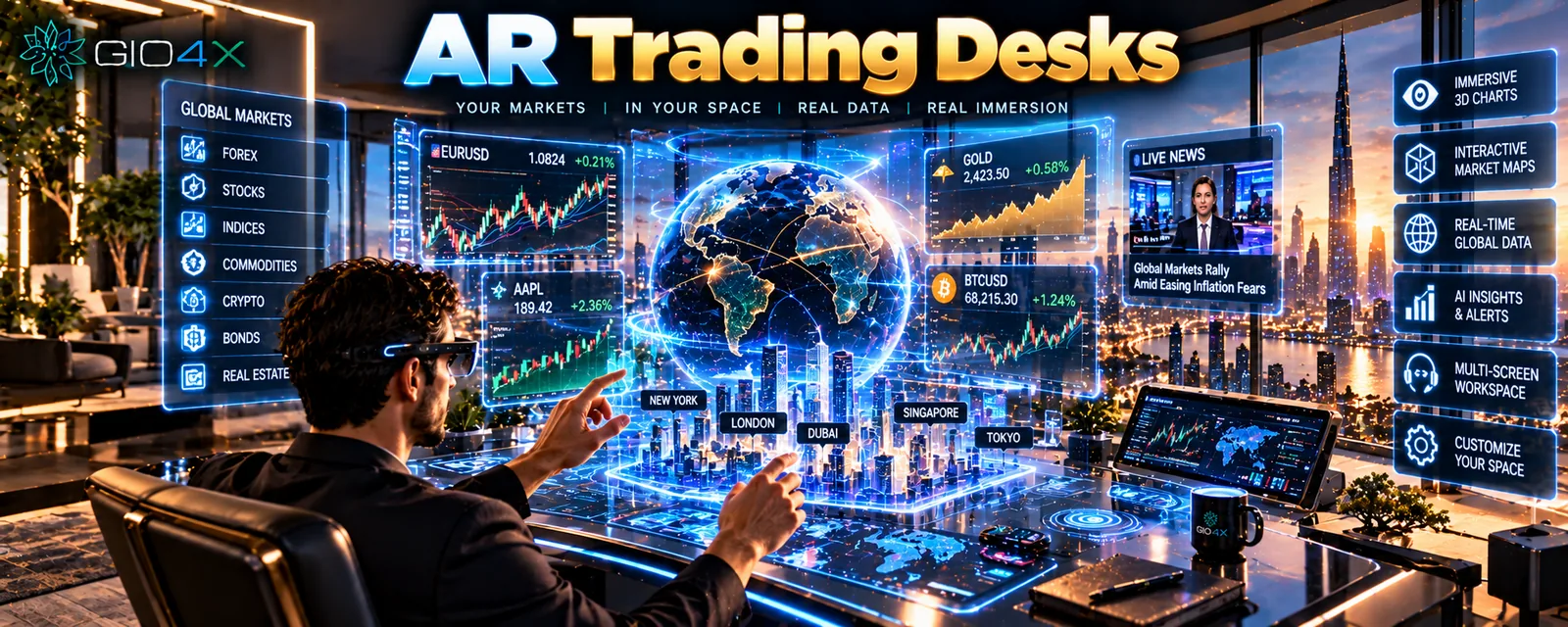
A wall of trading monitors can now fit inside a headset. The software can place virtual screens around a desk, but weight, comfort and cost still limit all-day use. For now, the clearest benefit is portable screen space.
Key takeaway. AR is most useful when it solves a real screen-space problem. Comfort, legibility and precise input matter more than the novelty of a three-dimensional chart.
Why traders have so many screens
The multi-monitor desk exists because trading is a monitoring job. A trader wants charts on several timeframes, an order book, positions, news and a chat window in view at once, without switching.
Each extra monitor adds pixels and also adds cost, heat, cabling and desk space. A professional setup with six screens, arms and a workstation runs to several thousand dollars and cannot be moved.
Augmented reality offers the same pixels without the hardware.
What AR actually means here
Three terms get mixed together.
- Virtual reality replaces your view entirely with a generated one.
- Augmented reality overlays digital objects on the real world, which you still see.
- Mixed reality or spatial computing does the same through a headset that uses cameras to show you the room, with virtual objects fixed in place.
For trading, the third is the relevant one. You see your real desk and keyboard, and floating above them are as many screens as you want, at any size.
What exists today
Banks experimented early. In 2016 Citi demonstrated a holographic workstation that showed market data in three dimensions beside a trader's normal screens. It stayed a prototype.
The arrival of high-resolution headsets in 2024 changed the picture. Text became sharp enough to read comfortably, and terminal and charting providers released versions for them. A trader can now pin a dozen windows around a room and control them by looking and pinching.
Lighter display glasses that plug into a laptop offer a simpler version: one or several large virtual monitors visible only to the wearer.
The advantages
Unlimited screen area. Add a window by reaching for it. There is no desk to run out of.
Portability. The whole desk fits in a bag. A hotel room or a kitchen table becomes a full workstation.
Privacy. Nobody beside you can see your positions.
Cost at the high end. One headset can be cheaper than a professional multi-monitor installation.
New ways to see data. Some information is naturally three-dimensional. An options volatility surface, plotted by strike and expiry, can be walked around. A portfolio can be laid out as a landscape, with risk as height.
Related posts
 AnalysisEducationVoice-Controlled TradingAsking a system for a price is one thing. Telling it to move money is another. Voice is becoming an effective way to query a trading account, but order placement still depends on precise read-back, secure confirmation and deliberate limits.@Abe4 min read
 AnalysisEducation