Part 1 of 15Institutional Trading
@AbePublished 5 min read

Fetching the page
Education · Analysis
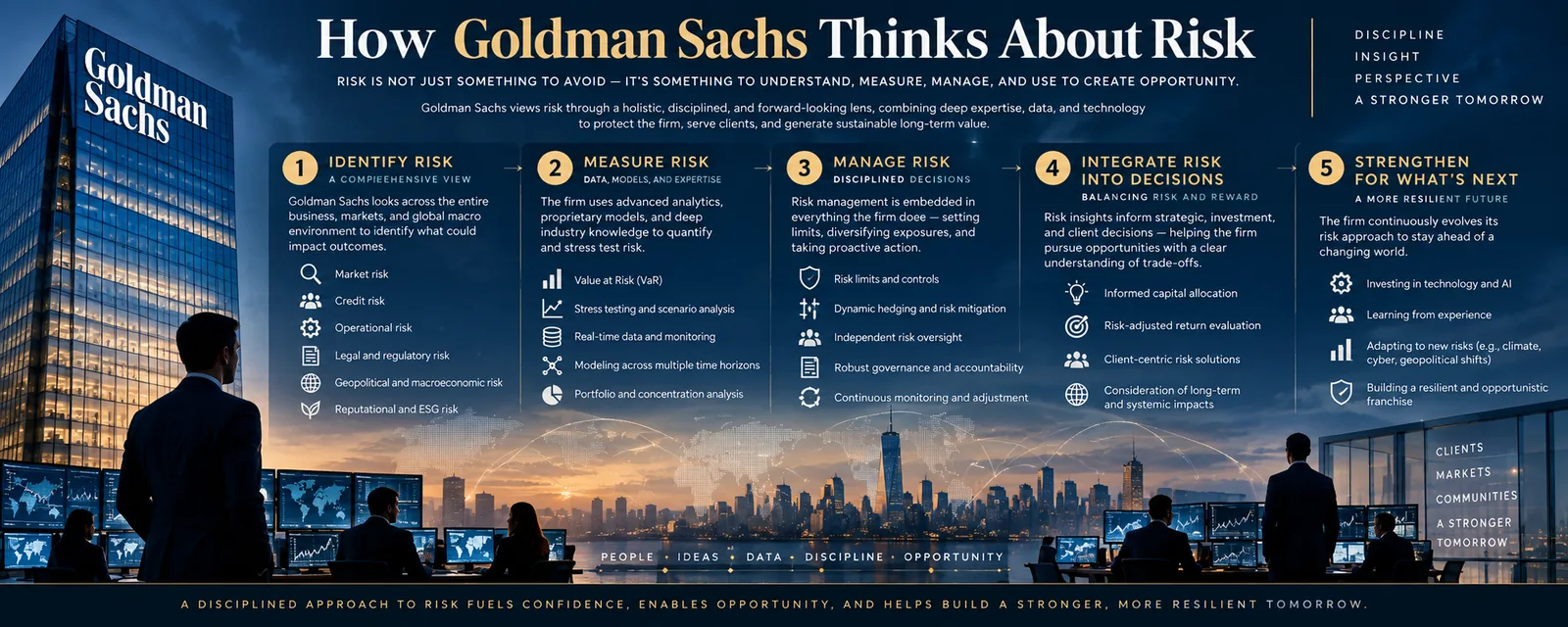
The first question in institutional trading is how much can be lost, how quickly, and who will act. Goldman Sachs offers a useful lens on that discipline: risk is measured, challenged and escalated throughout the life of a position.
Part 1 of 15Institutional Trading
@AbePublished 5 min read
Risk limits, daily valuation and the discipline of escalation
The first question in institutional trading is how much can be lost, how quickly, and who will act. Goldman Sachs offers a useful lens on that discipline: risk is measured, challenged and escalated throughout the life of a position.
Desk insight. Small, repeated losses deserve investigation even when no headline limit has been breached.
A retail trader usually asks, “How much can I make on this?” A firm like Goldman asks, “How much can this cost us, how fast, and who will notice first?” The second question sounds less exciting. It is also the reason some firms survive several crises and others disappear in one.
At a well-controlled bank, a proposed position is assessed against exposure limits before it is opened. Risk is expressed in a common language so that the desk and the control functions can challenge the same numbers.
That language has several dialects. Value at Risk estimates a loss threshold over a defined period at a specified confidence level; losses beyond that threshold remain possible. Sensitivities measure the effect of changes such as a one-basis-point rate move, a one-point volatility move or a one-percent currency move. Concentration limits constrain exposure to a name, sector or counterparty.
None of these numbers is treated as the truth. Each one answers a narrow question, and the people using them know the question is narrow. The point is to have many imperfect views of the same book rather than one comfortable story.
Daily valuation is central to trading risk control. Positions are assessed at current fair value rather than simply carried at their purchase price. Where reliable market quotes are unavailable, models and independent valuation checks become especially important.
This sounds like accounting. It is really psychology. A position marked at today’s price cannot hide a loss, and a loss that cannot hide gets discussed.
Retail traders do the opposite all the time. A losing trade becomes “a long-term hold”. The entry price becomes an anchor, and the account is judged by what it would be worth if price came back. Marking to market removes that escape route.
The best-known illustration comes from the months before the subprime crisis. According to published accounts, Goldman’s mortgage business recorded a run of daily losses in December 2006. The losses were small compared with the size of the firm.
What matters is what happened next. Senior executives, including the finance and risk leadership, sat down with the mortgage desk and went through the positions line by line. The reported conclusion was to cut exposure and move closer to neutral.
The reported lesson is the speed of the response. A pattern of daily losses prompted scrutiny and a reduction in exposure, rather than reassurance from a single model or limit.
This did not make the firm immune. Goldman still took heavy hits in 2008, accepted government support along with its peers, and later paid large settlements over its mortgage activities. The lesson is narrower and more useful: small, repeated losses are a message, and someone must be paid to read it.
The 2008 crisis exposed the danger of treating Value at Risk as a complete account of risk. Its usefulness depends on the assumptions, data and time horizon. It does not tell a desk how severe losses beyond its threshold could become.
The better approach treats the model as one voice in the room. Stress tests ask a different question: what if 1998, 2008 or a scenario nobody has seen happens tomorrow? The answer is rarely precise, but it shows which positions would hurt together.
Judgment fills the gap. If a desk is making money too easily, a good risk manager asks why. If losses arrive in a pattern the model says is unlikely, the model is doubted before the market is.
Independent risk functions should be able to challenge the businesses they oversee. Reporting lines and compensation arrangements matter because a control loses force when its incentives are tied too closely to the desk's profit.
Accounts of Goldman’s culture also describe people moving between trading and control roles. A risk manager who has run a book knows where the bodies are usually buried. A trader who has worked in risk knows the limit is not an insult.
Escalation completes the system. Bad news is expected to travel upward quickly, and hiding a problem is treated as worse than having one. A loss reported today is a risk decision. A loss discovered next month is a scandal.
A position is only as safe as the exit. Banks ask how long it would take to sell a holding without moving the price, and they size positions with that answer in mind.
They ask the same question about funding. A firm that borrows short to hold long-dated assets can face a financing crisis even before it can realise an asset's value. At Bear Stearns and Lehman Brothers, asset losses, leverage, confidence and funding pressure reinforced one another.
You do not need a risk committee to borrow the logic.
Key takeaway. The transferable lesson is a set of practical habits: current valuations, explicit limits, several views of the same exposure, and rapid escalation when the evidence changes.
A small account can adopt the habits without recreating a bank's infrastructure. The rules matter only if they change decisions.
Part 1 of 15 in the series Institutional Trading. Next: What Hedge Funds See That Retail Traders Usually Miss.
Independent educational commentary, not investment advice. References to firms do not imply affiliation or endorsement. Figures in examples illustrate a method, not a recommended allocation or a promised outcome. Trading leveraged products carries a high risk of loss.
 AnalysisEducationTrade Like a Desk, Not Like a GamblerThe same entry can belong to a disciplined trading business or an impulsive bet. The difference sits around the order: a mandate, a repeatable setup, a risk budget and an honest review.@Abe5 min read
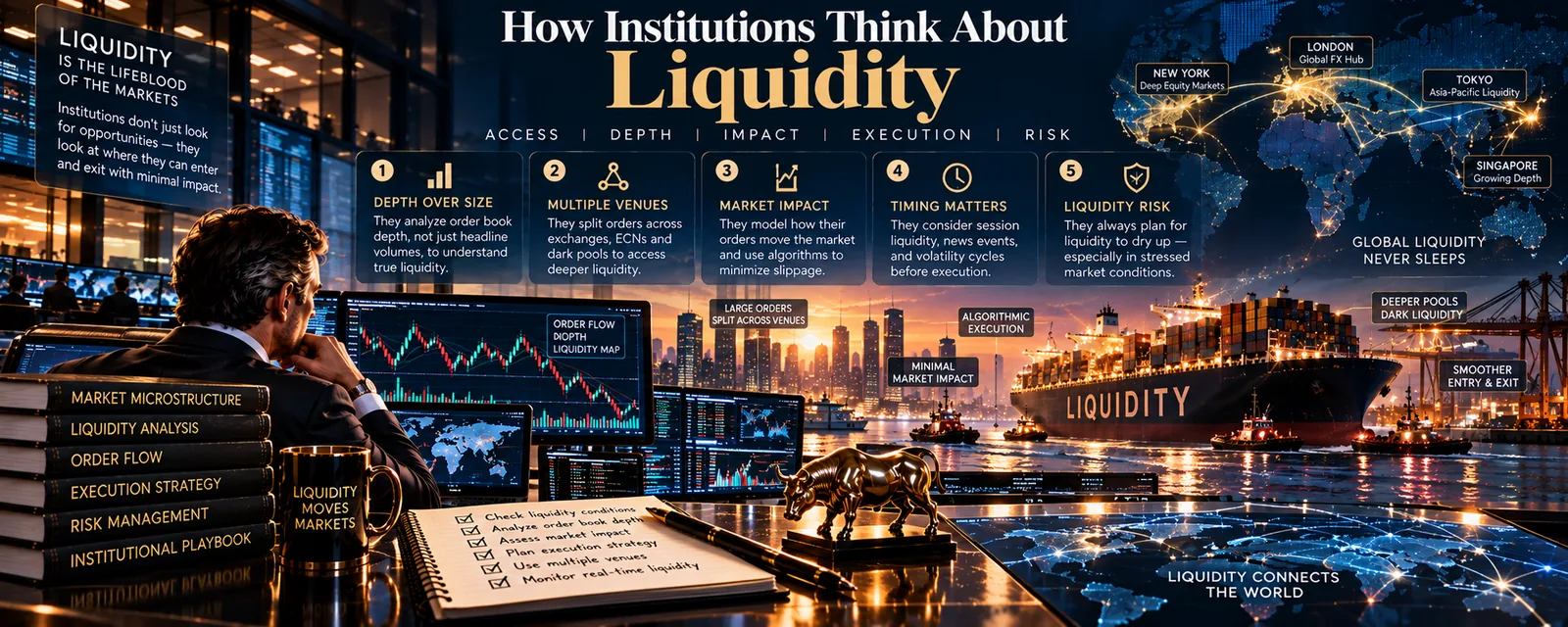 AnalysisEducationHow Institutions Think About LiquidityLiquidity is the price of getting something done. An institution asks how much it can trade, how quickly, and how far its own orders could move the market. The answer shapes both entry and exit.@Abe5 min read
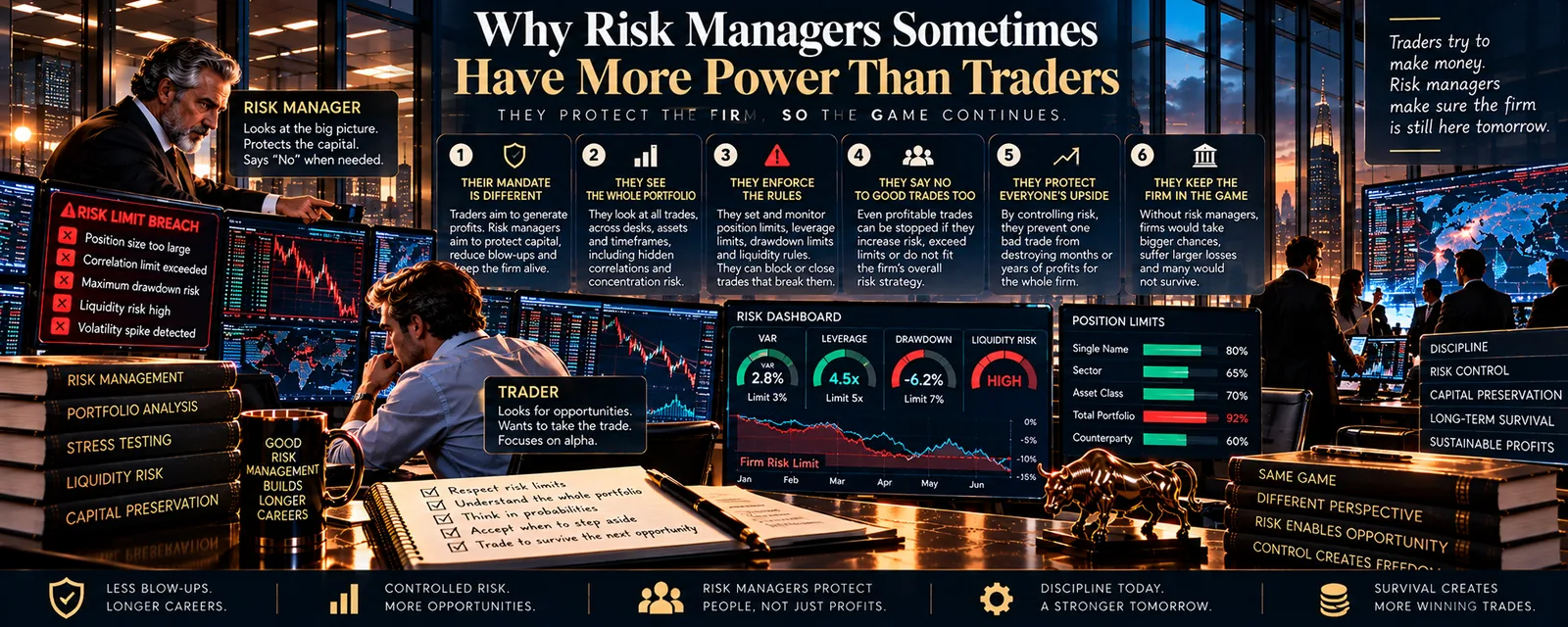 AnalysisEducationWhy Risk Managers Sometimes Have More Power Than TradersThe trader manages an opportunity; the risk function challenges whether the firm can afford it. When those judgments collide, effective governance gives risk officers the authority to reduce exposure and escalate the decision.@Abe6 min read
A short note from a GIO4X desk, filed under Education. It explains; it does not forecast and it does not tell you to trade. GIO4X is a broker and earns money when clients trade.
Editorial standardshttps://www.gio4x.com/intelligence/blog/how-goldman-sachs-thinks-about-risk
Printed from gio4x.com.