Part 9 of 15Institutional Trading
@AbePublished 5 min read


Fetching the page
Education · Analysis
Liquidity is the price of getting something done. An institution asks how much it can trade, how quickly, and how far its own orders could move the market. The answer shapes both entry and exit.
Part 9 of 15Institutional Trading
@AbePublished 5 min read
Spreads, market depth, funding pressure and the cost of exit
Liquidity is the price of getting something done. An institution asks how much it can trade, how quickly, and how far its own orders could move the market. The answer shapes both entry and exit.
Desk insight. The exit price under stress can matter more than the spread visible at entry.
Small orders in liquid markets often face less impact, so the constraint is easy to overlook. Yet even a small order can slip, and a quoted price may cover only the first fraction of a fund's order.
Professionals break the idea into parts.
The three dimensions of market liquidity
| Dimension | The question it answers | What a trader sees |
|---|---|---|
| Tightness | What does a small round trip cost? | The bid-ask spread |
| Depth | How much size sits near the current price? | Order book volume at each level |
| Resilience | How quickly does price recover after a large trade? | Speed at which the book refills |
A market can be tight but shallow. The spread is narrow, yet a moderately large order walks straight through the book. This is common outside peak hours.
Every trade pays for immediacy. A small trader pays the spread. A large trader pays the spread plus market impact, the amount price moves because of the order itself.
Impact grows with order size relative to normal volume. Funds therefore measure positions in days of volume. A holding equal to five days of average trading cannot be sold in an afternoon at anything like the screen price.
This is why institutions break orders up, use algorithms, and trade during the busiest hours. The later posts in this series cover that in detail.
The more serious point is that liquidity is not constant. It is plentiful when nobody needs it and scarce when everybody does.
In calm markets, dealers and market makers quote in size. In a shock, they widen spreads and cut size to protect themselves. The depth that was visible an hour ago is gone.
So the cost of exit is highest exactly when exit is most wanted. A risk model that assumes normal liquidity will understate the loss in a crisis. Good firms apply a discount to positions they could not sell quickly.
Institutions separate two things that share a name.
Market liquidity is the ability to sell an asset near its current price.
Funding liquidity is the ability to keep financing the position: meeting margin calls, rolling short-term borrowing, paying redemptions.
The two feed each other. Prices fall, margin calls rise, funds sell to meet them, prices fall further. This spiral was at the centre of 2008 and of several sharp episodes since.
A leveraged retail account can face a similar loop. An adverse move reduces equity and may lead to a margin shortfall or broker liquidation. Required margin may also change, depending on the instrument and broker.
A trader’s instinct is to size by conviction. An institution sizes by exit.
Before buying, the desk asks how long it would take to get out under stress and what it would cost. If the answer is uncomfortable, the position is made smaller, however good the idea.
This is also why very large funds avoid small markets entirely. The opportunity may be real, but they cannot fit through the door.
Large orders need counterparties. A fund that wants to buy in size needs many sellers at once, so it looks for places where selling is likely to appear.
Orders may cluster around well-watched highs, lows and round numbers, while option-related hedging can affect flows near strikes. A chart alone cannot reveal the full order book or the intentions behind it.
This gives rise to a familiar pattern. Price pushes through an obvious level, triggers the orders resting there, and then reverses. Large players can use that burst of activity to fill size.
Some caution is needed here. Much retail content describes this as a deliberate hunt aimed at small traders. The plainer explanation usually fits better: orders gather at obvious points, and price is drawn to where business can be done. Not every spike through a level is a trap, and many breakouts simply continue.
Liquidity follows a daily rhythm. In currencies, depth is greatest when London and New York are both open. In equities, the open and the closing auction carry a large share of the volume.
Institutions often schedule execution around active windows. More volume can help an order find counterparties, but auctions, fixing windows and news can also bring concentrated demand and volatility.
The quiet periods carry their own hazards. Spreads widen around the daily rollover in currencies. Holiday sessions are thin. Sudden moves in illiquid hours, sometimes called flash crashes, tend to happen when few participants are present.
A small order often has little impact in a liquid market. Liquidity still affects the trader in at least five ways.
Before entering, ask the institutional question in a retail form: “If I am wrong at the worst possible moment, such as during news or over a weekend, what price will I actually get?”
If the honest answer is much worse than the stop level, the position is too large for the conditions.
Key takeaway. Institutions treat liquidity as a cost to manage, a risk to respect and a guide to where price is likely to do business. It governs how large they trade, when they trade, and how they leave.
A small trader is spared the impact problem. The other lessons apply in full: count the spread, respect thin markets, and never assume the exit will be there at the price you planned.
Part 9 of 15 in the series Institutional Trading. Next: What Actually Happens When a Billion-Dollar Order Hits the Market.
Independent educational commentary, not investment advice. References to firms do not imply affiliation or endorsement. Figures in examples illustrate a method, not a recommended allocation or a promised outcome. Trading leveraged products carries a high risk of loss.
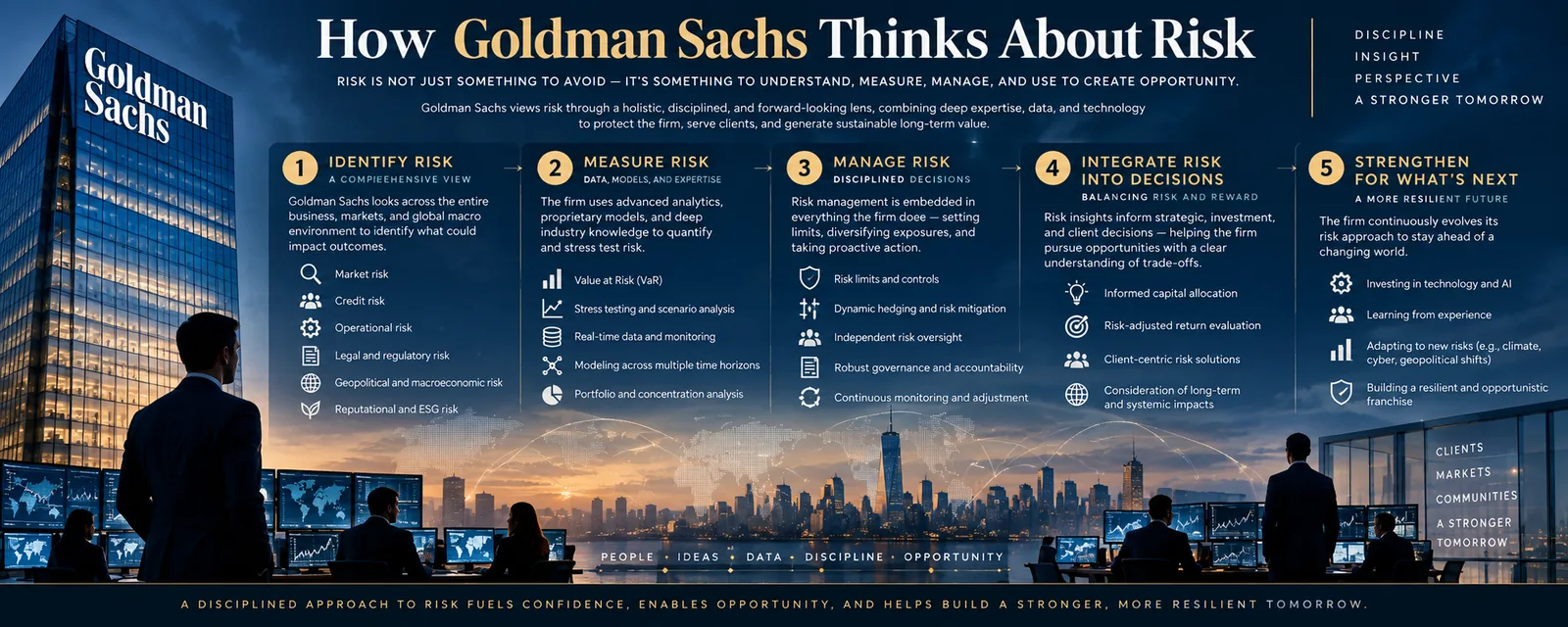 AnalysisEducationHow Goldman Sachs Thinks About RiskThe first question in institutional trading is how much can be lost, how quickly, and who will act. Goldman Sachs offers a useful lens on that discipline: risk is measured, challenged and escalated throughout the life of a position.@Abe5 min read
 AnalysisEducationThe Anatomy of an Institutional TradeA trade starts long before the order and ends after the exit. This seven-stage framework follows an institutional idea through research, instrument choice, risk approval, execution, management and review.@Abe6 min read
 AnalysisEducationTrade Like a Desk, Not Like a GamblerThe same entry can belong to a disciplined trading business or an impulsive bet. The difference sits around the order: a mandate, a repeatable setup, a risk budget and an honest review.@Abe5 min read
A short note from a GIO4X desk, filed under Education. It explains; it does not forecast and it does not tell you to trade. GIO4X is a broker and earns money when clients trade.
Editorial standardshttps://www.gio4x.com/intelligence/blog/how-institutions-think-about-liquidity
Printed from gio4x.com.