Part 10 of 15Institutional Trading
@AbePublished 6 min read

Fetching the page
Education · Analysis
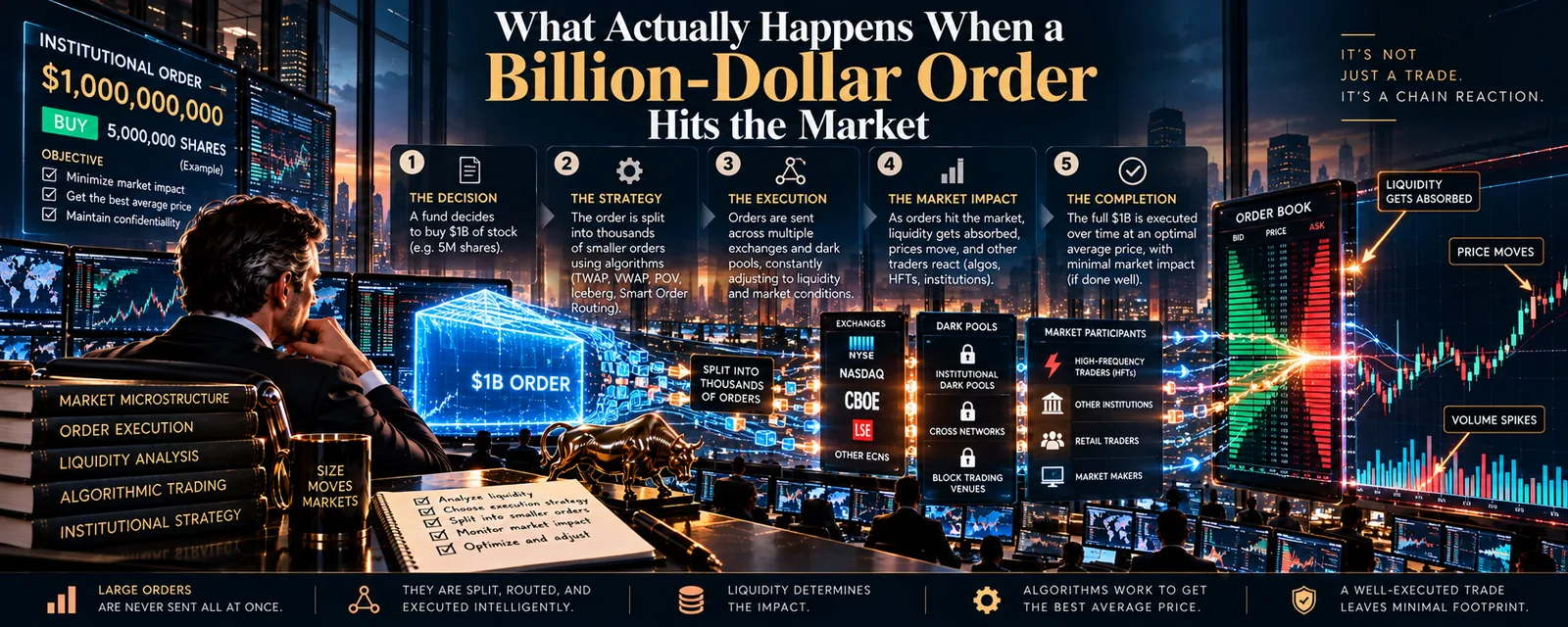
A billion-dollar equity order can become a project lasting several sessions. The execution desk divides the instruction, finds counterparties and balances speed against market impact. The route depends on liquidity and urgency.
Part 10 of 15Institutional Trading
@AbePublished 6 min read
Inside order slicing, block trading and execution algorithms
A billion-dollar equity order can become a project lasting several sessions. The execution desk divides the instruction, finds counterparties and balances speed against market impact. The route depends on liquidity and urgency.
Desk insight. At 20% participation in $500 million daily turnover, a $1 billion order takes about ten trading days, assuming steady volume.
The popular image is a giant buy button and a vertical candle. The reality is quieter and more interesting. The largest trades are usually the hardest to see while they are happening.
A portfolio manager decides to buy a billion dollars of a large company’s shares. The investment case is finished. The execution problem has just begun.
Suppose the stock trades about 500 million dollars a day. The order equals two days of that total turnover. A rapid purchase would require unusually large participation or a block counterparty; average volume alone does not promise that supply.
The manager does not place the order. It goes to the fund’s execution desk, a team whose only job is to buy and sell well.
The execution trader starts with a pre-trade analysis. Models estimate the cost of the order under different speeds, using the stock’s volume, volatility and spread.
The trade-off is simple to state. Trade fast and the order pushes the price up. Trade slowly and the price may drift away while the fund waits, or others may detect the buying.
An illustrative plan caps participation at 20 percent of market volume. If daily turnover stays at 500 million dollars, the fund buys 100 million a day and needs about ten trading days. Actual participation limits depend on the security, urgency and execution objective.
Before touching the public market, the desk looks for natural sellers. The cheapest fill is a large holder who wants to sell the same day.
Block trades. A bank’s desk may know of a seller or may sell from its own inventory at an agreed price. A large slice changes hands in one print, away from the visible order book.
Dark pools and crossing networks. These venues match buyers and sellers without displaying orders in advance. A fund can rest a large buy order there and see whether another institution arrives on the other side.
The benefit is reduced information leakage. The limits are uncertain fills and the risk of trading against someone who has worked out what is resting there.
What cannot be crossed quietly is worked in the open market by an execution algorithm. The large instruction is called the parent order. The small pieces sent to the market are child orders.
Execution algorithms and objectives
| Algorithm type | What it tries to do | When it is used |
|---|---|---|
| VWAP | Track volume-weighted average price over the execution period | Benchmark-sensitive orders |
| TWAP | Trade on a time-based schedule | When even pacing fits the objective |
| Percentage of volume | Stay at a fixed share of market volume | Keeping a low footprint |
| Implementation shortfall | Balance impact, delay and opportunity cost | When the price may move away |
| Liquidity seeking | Hunt for size across lit and dark venues | Large or difficult orders |
The algorithm decides, second by second, how much to send, to which venue, and whether to post a passive order or cross the spread. It varies size and timing so the pattern is harder to spot.
A smart order router sits beneath it. Modern markets are split across many exchanges and venues, and the router sends each child order where the best price and depth are available.
Even a careful order leaves traces. Persistent buying shifts the balance in the order book. Market makers who keep selling to the same hidden buyer raise their quotes to protect themselves.
Some short-term traders specialise in detecting this. They look for repeated order sizes, regular timing, or a bid that keeps refilling. If they find it, they buy ahead and sell back to the fund higher.
Buying pressure may lift the price, but the outcome is not predetermined. Some impact may fade after execution; some may persist if the market revises its view. News and unrelated flows also influence the ten-day path.
Execution desks concentrate activity where volume is highest. In equities, the opening and closing auctions carry a large share of the day’s trading. A big order can participate there with less impact.
In currencies, the equivalent is the overlap of the London and New York sessions and the daily fixing windows. Large corporate and fund flows cluster around those times.
Sometimes the fund cannot wait ten days. News is coming, or the idea is widely known.
Then it can ask a bank for a risk price. The bank buys or sells the whole block immediately at a discount or premium and takes on the job of unwinding it. The fund pays more and transfers the risk.
That price is the cost of immediacy in its purest form. It shows what the market charges to turn a slow trade into a fast one.
After the last fill, the trade is graded. Transaction cost analysis compares the average price paid with several benchmarks.
A central measure is implementation shortfall: the difference between a decision-price benchmark portfolio and the actual implementation, including relevant trading costs and any unexecuted portion. For a fully filled order, the average execution-price gap is a useful component. A fraction of one percent on a billion dollars amounts to millions.
Those results feed back into the next plan. Which algorithm worked, which venue leaked, which broker performed. Execution is treated as a skill that can be measured and improved.
None of these is proof of a large order, but they are common footprints.
These patterns can accompany gradual accumulation, but they also have other causes. Use them as context rather than as proof of institutional buying.
Key takeaway. A billion-dollar order is a logistics project. It involves a specialist desk, models, hidden venues, algorithms and a post-trade review, all designed to buy without announcing it.
The drama retail traders imagine is exactly what the institution is paying to avoid.
Part 10 of 15 in the series Institutional Trading. Next: Why Large Funds Cannot Simply “Buy at Market”.
Independent educational commentary, not investment advice. References to firms do not imply affiliation or endorsement. Figures in examples illustrate a method, not a recommended allocation or a promised outcome. Trading leveraged products carries a high risk of loss.
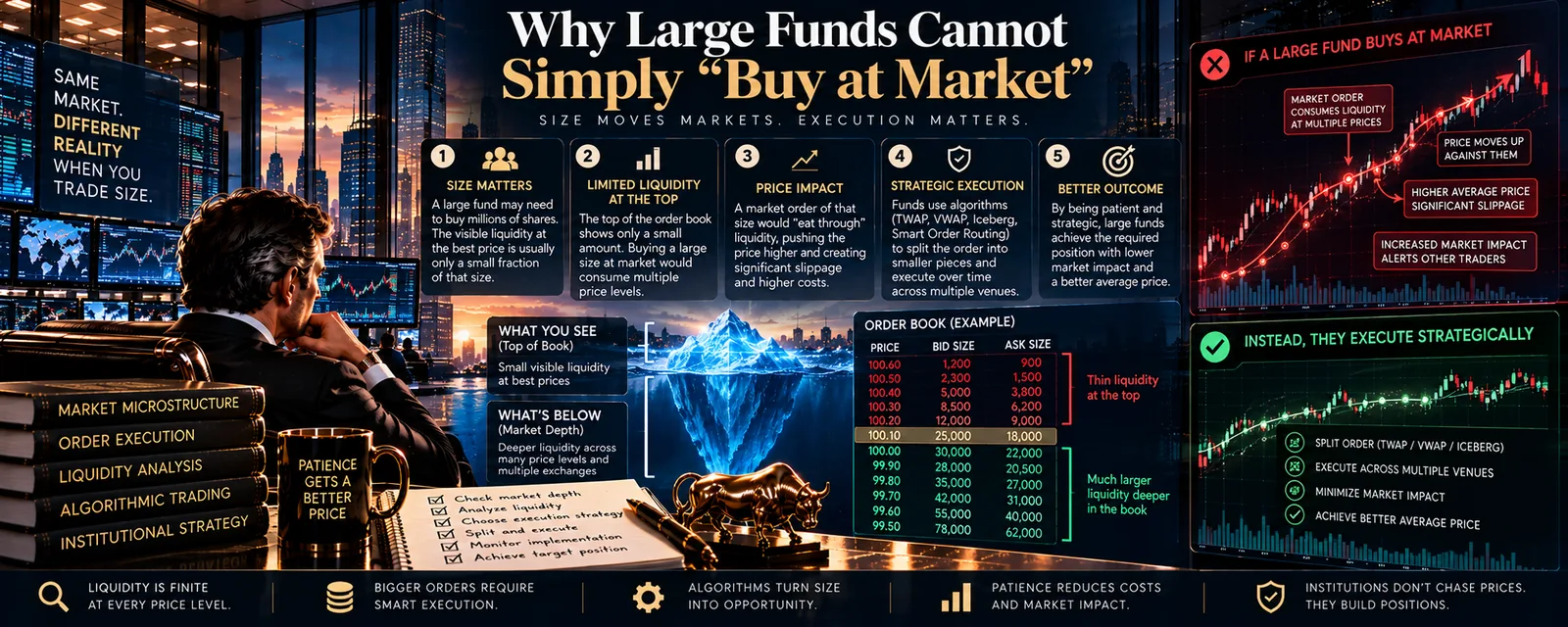 AnalysisEducationWhy Large Funds Cannot Simply “Buy at Market”A screen quote is a price for available size, not a promise to fill an entire fund. Once that size is consumed, a large order can move through progressively worse prices. Execution quality becomes part of the investment result.@Abe6 min read
 AnalysisEducationWhat Happens When AIs Trade Against Other AIs?Machines have been trading against machines for more than a decade. The result is familiar: tighter spreads, fewer simple opportunities and failures that can unfold at extraordinary speed. Learning systems add a harder question—what happens when those machines adapt to one another?@Abe4 min read
 AnalysisEducationHuman Trader versus AI TraderA machine can watch thousands of markets without blinking. A human can recognise that the assumptions behind its signals have broken. Speed, breadth and consistency favour AI; context and unfamiliar situations still leave room for judgment. Your trading edge determines which strengths you need.@Abe3 min read