Part 11 of 15Institutional Trading
@AbePublished 6 min read

Fetching the page
Education · Analysis
A screen quote is a price for available size, not a promise to fill an entire fund. Once that size is consumed, a large order can move through progressively worse prices. Execution quality becomes part of the investment result.
Part 11 of 15Institutional Trading
@AbePublished 6 min read
Order book depth, slippage and the real cost of urgency
A screen quote is a price for available size, not a promise to fill an entire fund. Once that size is consumed, a large order can move through progressively worse prices. Execution quality becomes part of the investment result.
Desk insight. On a $1 billion order, 0.1% of execution shortfall equals $1 million.
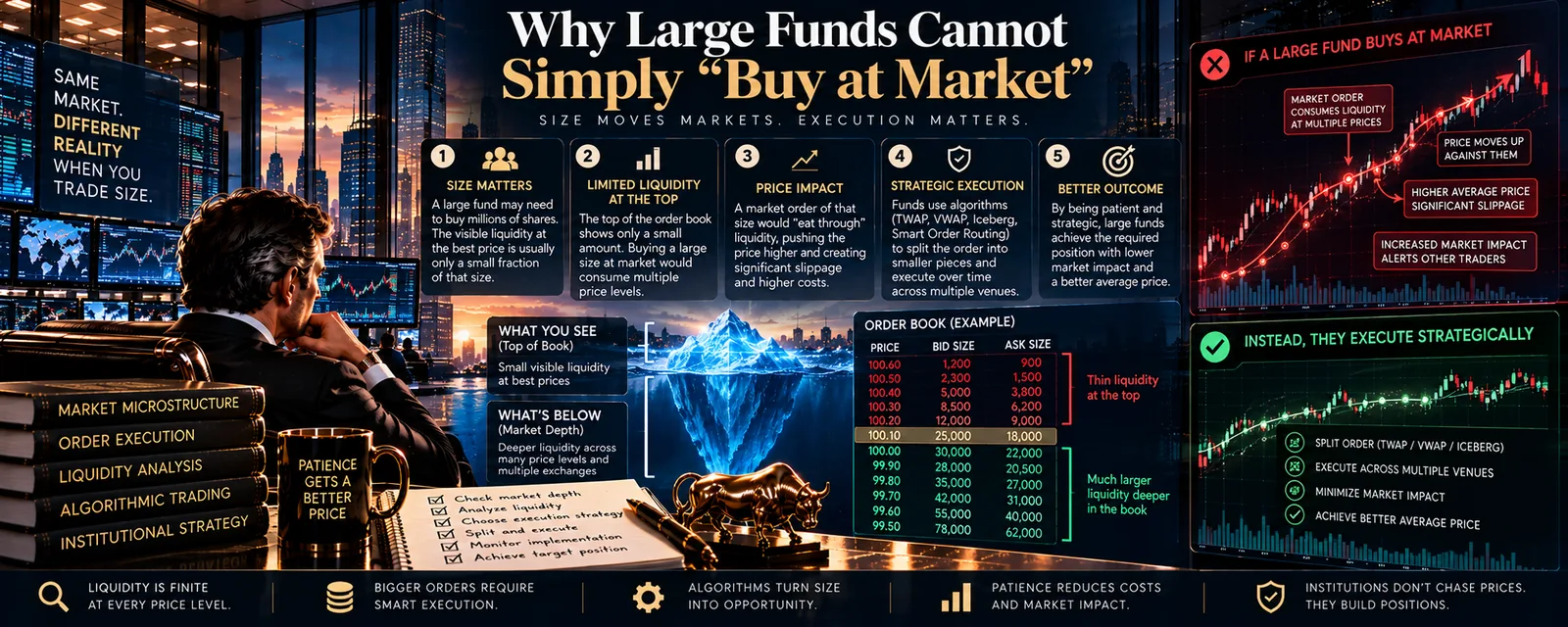
A market order asks for execution at the best available prices. It does not lock in the screen quote for either a retail trader or a fund. Larger orders are more likely to exhaust the quantity available at that quote.
A quote is an offer to trade a limited amount. Behind the best offer sits the next best, at a slightly worse price, and so on. This ladder is the order book.
Here is a simplified sell side for a stock.
Illustrative sell-side order book
| Offer price | Shares available |
|---|---|
| 100.00 | 5,000 |
| 100.01 | 10,000 |
| 100.02 | 15,000 |
Assuming the displayed offers remain available, 100 shares fill at 100.00. Buying all 30,000 shares gives a weighted average of (5,000 × 100.00 + 10,000 × 100.01 + 15,000 × 100.02) ÷ 30,000 = 100.01333. The last fill is 100.02, before fees.
Now imagine a fund that wants five million shares. The visible book holds 30,000. A market order of that size would sweep every offer on the screen and keep going into whatever sellers appear, at whatever price they ask.
Traders call this walking the book. Each level consumed pushes the next fill higher. The difference between the expected price and the average price received is slippage.
Slippage may be small for modest orders in liquid conditions. For large or urgent orders it can dominate commissions and the quoted spread; even small orders can slip sharply during stress.
Empirical execution research often finds a concave relationship between impact and order size, with a square-root approximation over some ranges. It is a model, not a universal law, and depends on the market and execution conditions.
The size relationship does not by itself measure the effect of trading faster. Urgency and participation rate also matter: consuming liquidity more aggressively can raise costs, while waiting creates exposure to price drift.
Temporary impact comes from using up liquidity. Price is pushed away and drifts back once the pressure stops. The fund has paid a premium for immediacy.
Permanent impact comes from information. Other participants see determined buying and conclude someone knows something. They raise their own valuations, and the price does not return.
A large aggressive order can both consume depth and reveal demand. The amount and persistence of its impact depend on the market response.
The second problem is being seen. A large visible order tells everyone the direction, the urgency and something about the size.
Market makers respond by moving quotes away. Fast traders buy ahead and offer the shares back higher. Other funds holding the same idea rush to get in first.
This is why institutions hide. They use hidden and iceberg orders that show only a small part of their size. They trade in dark venues. They randomise the size and timing of each piece.
Implementation shortfall compares the actual trade with a benchmark portfolio established at the decision price. For a fully completed order, the execution-price gap and fees are central components; partial execution also raises delay and opportunity costs.
The components of execution cost
| Component | What it is |
|---|---|
| Spread cost | Paying the offer when buying, hitting the bid when selling |
| Market impact | Price moved by the fund’s own orders |
| Delay cost | Price drift while the order waits to be worked |
| Opportunity cost | Profit missed on the portion never filled |
| Fees | Commissions and exchange charges |
Immediate execution can reduce delay but increase impact. Slow execution can reduce pressure on the book while leaving the order exposed to price drift or non-completion. The objective is the best total result for the mandate.
A small percentage matters at this scale. On a billion-dollar purchase, each tenth of one percent of shortfall is a million dollars. A strategy with a modest edge can lose all of it in execution.
Best-execution obligations can require firms to assess how orders are handled for clients. The applicable standard depends on jurisdiction, service and client type; price is only one of the relevant factors.
A large aggressive order may be justified by urgency or risk reduction. Execution policies, broker reviews and cost reports help document why the chosen approach was reasonable in the circumstances.
Most of these trade speed for cost. The fund accepts that it may take days to finish.
Sometimes there is no choice. A margin call, a liquidation, a stop-out or a panic forces someone to sell immediately at any price.
The May 2010 flash crash illustrates how urgent execution can interact with fragile liquidity. The joint SEC–CFTC review described a large automated futures sell programme operating without regard to price or time, alongside feedback between participants and markets. It was not a single-order explanation of the entire event.
Forced market orders are what the patient side of the market waits for. One participant’s emergency is another’s discount.
Small orders often have modest impact in liquid markets, but their execution costs still deserve measurement.
Match the order type to the objective. A limit order controls price but may not fill; a market order prioritises execution without guaranteeing price. Record slippage and missed fills to understand the trade-off for your strategy.
Key takeaway. Large funds avoid market orders because size changes the meaning of price. Past the first few thousand shares, the cost of a trade is whatever the trader’s own urgency creates.
Patience and concealment are how institutions keep that cost down. The lesson for smaller traders is modest but real: the price you see is not always the price you get, and the difference is worth measuring.
Part 11 of 15 in the series Institutional Trading. Next: The Anatomy of an Institutional Trade.
Independent educational commentary, not investment advice. References to firms do not imply affiliation or endorsement. Figures in examples illustrate a method, not a recommended allocation or a promised outcome. Trading leveraged products carries a high risk of loss.
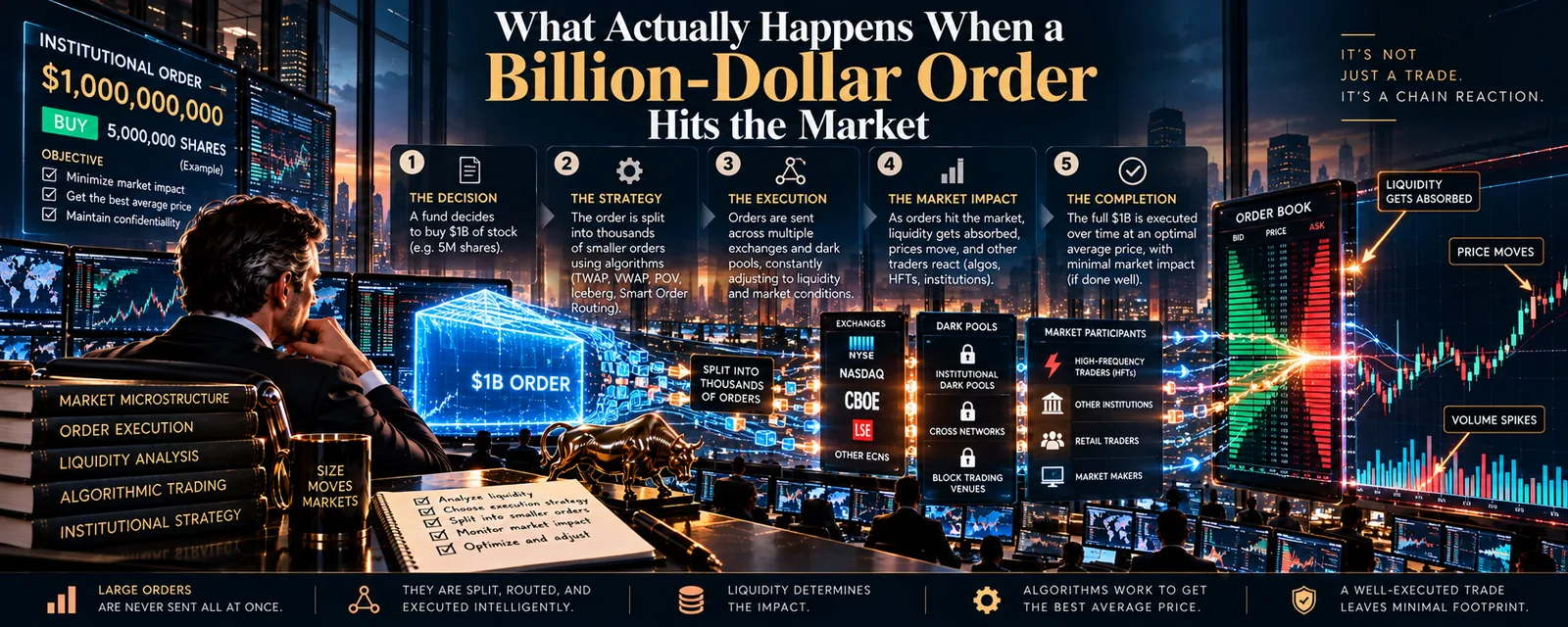 AnalysisEducationWhat Actually Happens When a Billion-Dollar Order Hits the MarketA billion-dollar equity order can become a project lasting several sessions. The execution desk divides the instruction, finds counterparties and balances speed against market impact. The route depends on liquidity and urgency.@Abe6 min read
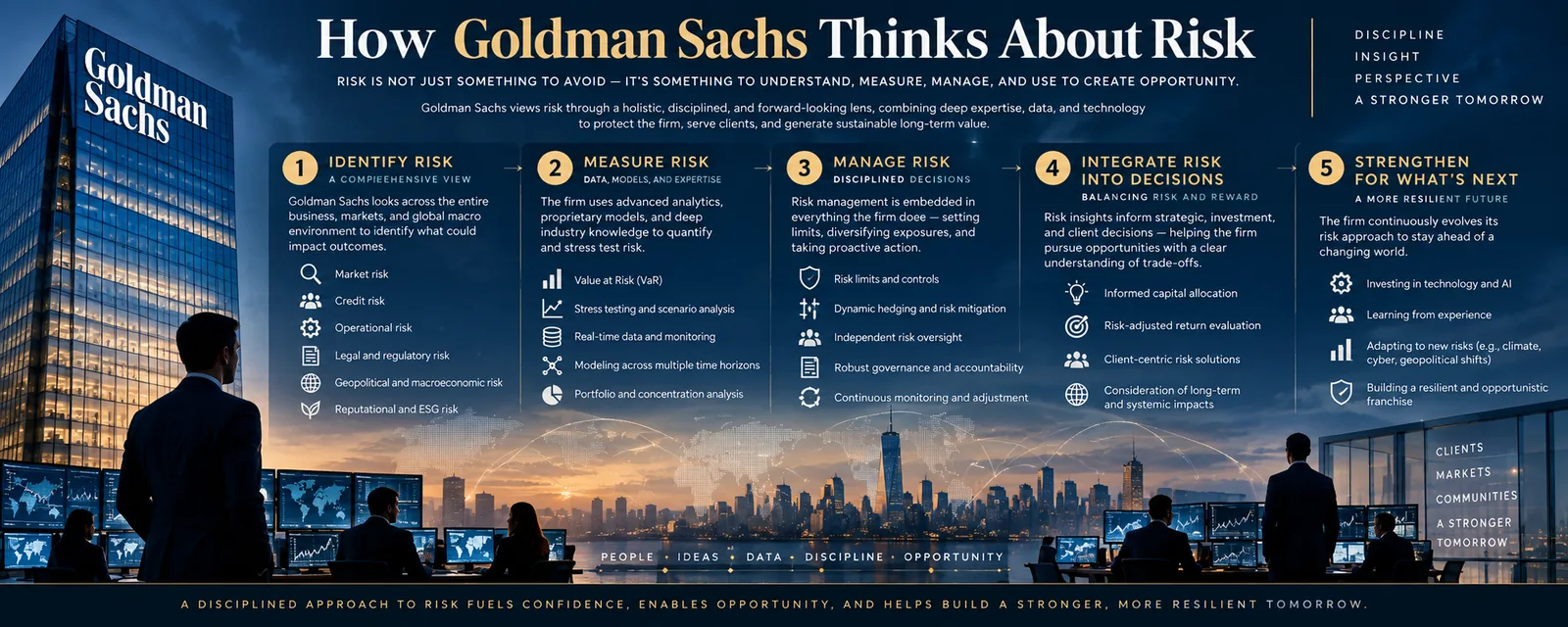 AnalysisEducationHow Goldman Sachs Thinks About RiskThe first question in institutional trading is how much can be lost, how quickly, and who will act. Goldman Sachs offers a useful lens on that discipline: risk is measured, challenged and escalated throughout the life of a position.@Abe5 min read
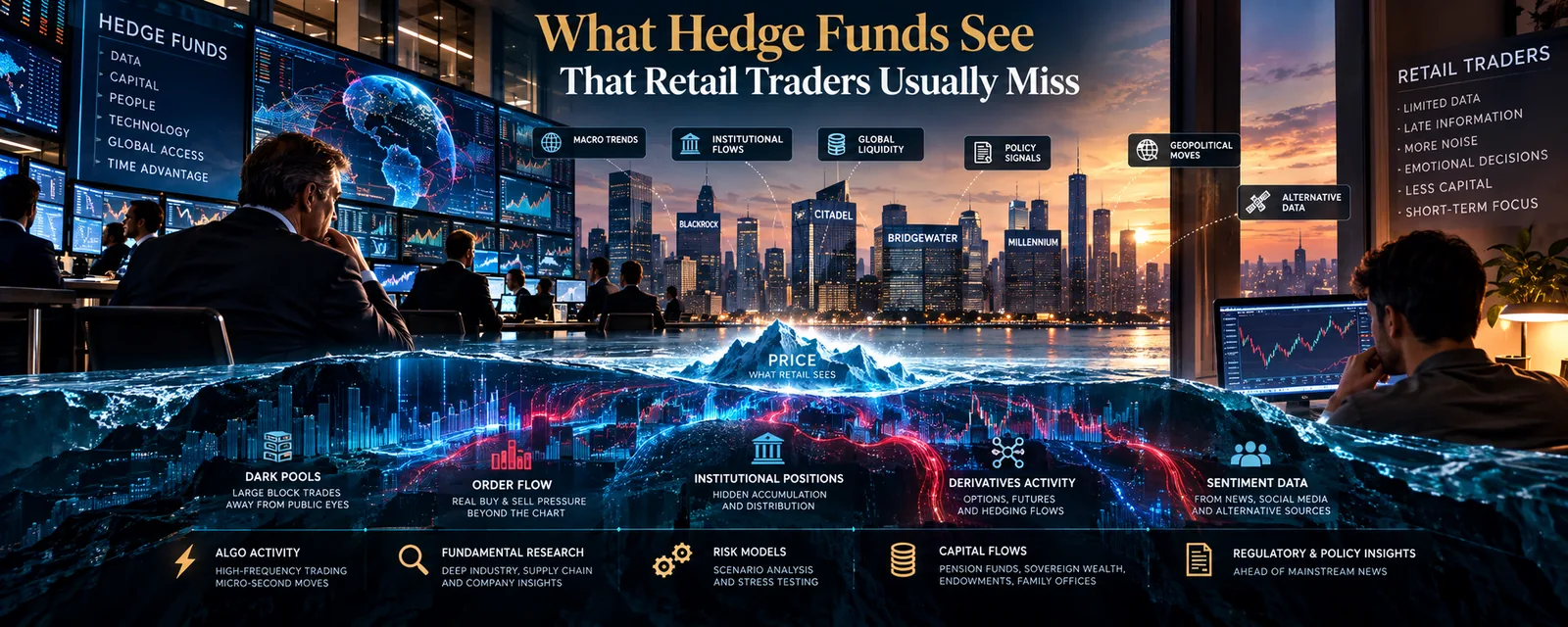 AnalysisEducationWhat Hedge Funds See That Retail Traders Usually MissThe chart shows price. A hedge fund also asks who holds the trade, what it costs to carry, and which other positions would lose alongside it. That wider view can change a decision before the first order is sent.@Abe5 min read