Part 12 of 15Institutional Trading
@AbePublished 6 min read

Fetching the page
Education · Analysis
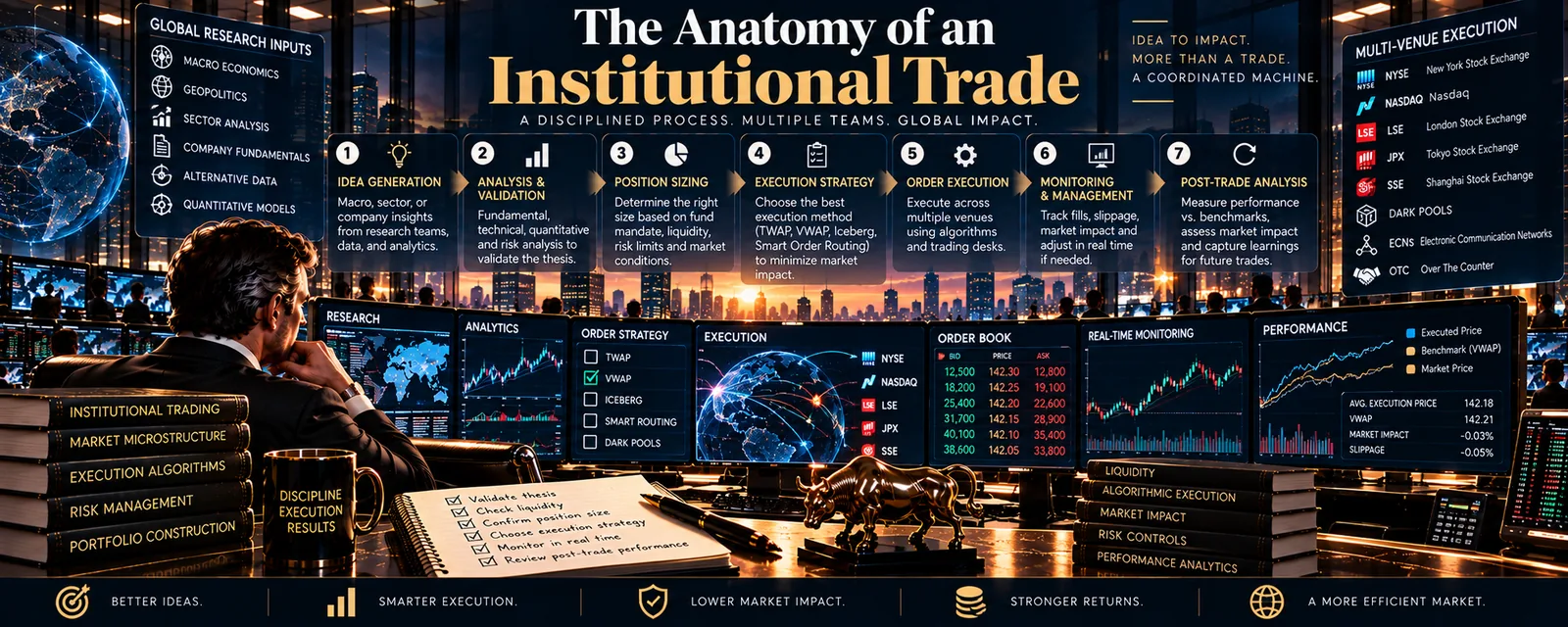
A trade starts long before the order and ends after the exit. This seven-stage framework follows an institutional idea through research, instrument choice, risk approval, execution, management and review.
Part 12 of 15Institutional Trading
@AbePublished 6 min read
From investment thesis to execution, exit and review
A trade starts long before the order and ends after the exit. This seven-stage framework follows an institutional idea through research, instrument choice, risk approval, execution, management and review.
Desk insight. Idea → thesis → expression → sizing → execution → management → exit and review.
To make the stages concrete, this post follows one hypothetical trade. A macro fund comes to believe that a central bank will cut interest rates sooner than the market expects. Every detail is illustrative.
Ideas come from many places. An analyst notices that inflation components are cooling faster than the headline. A screen flags an unusual gap between two related markets. A trader hears that companies are delaying hiring.
Most ideas die here. A fund may review dozens for each one it trades. The filter is harsh by design, because research time and risk capital are both limited.
In our example, the idea is one sentence: “The economy is weakening faster than the central bank admits.”
An idea becomes a thesis when it can be written down, tested and proven wrong. The research note typically has to answer a set of questions.
The second question is the one beginners skip. In our case, rate futures show the market expects the first cut in nine months. The fund expects it in four. The trade is that five-month gap, not the general view that rates will fall.
The thesis also names its catalysts: the next two inflation prints and a central bank meeting. And it names its invalidation: a rebound in core inflation or wages.
The same view can be expressed through many instruments. Choosing well is a skill in its own right.
Ways to express a view on rate cuts
| Expression | Advantage | Drawback |
|---|---|---|
| Short-dated rate futures | Most direct link to the thesis | Loses if the timing is late |
| Government bonds | Deep, liquid market | Also exposed to long-term inflation views |
| Selling the currency | Simple to trade in size | Driven by other countries’ rates too |
| Options on rates | For purchased options, loss limited to premium plus costs | Premium decays while waiting |
| Equities that benefit from cuts | Larger upside | Weak economy may hurt earnings |
The fund looks for the cleanest link between the thesis and the payoff, the best reward for the risk, and the lowest cost to hold. Here it picks rate futures as the core, with a small options position for the scenario of a sudden large cut.
A correct view through the wrong instrument still loses money. This step is where much professional edge sits.
Now the trade meets the risk budget. The portfolio manager proposes a size based on the stop distance and the loss the fund will accept on this idea.
Risk management checks it against the whole book. Does the fund already hold positions that profit from lower rates? What happens in a stress scenario where inflation jumps? Can the position be exited within a day or two?
The outcome is a number and a set of conditions. Perhaps the idea may lose at most half a percent of fund capital. Perhaps it starts at one third of that and may be increased after the first catalyst.
The exit rules are written before entry: a price stop, a thesis stop and a time stop. If nothing has happened after the named catalysts, the position is closed even if it has not lost money.
The order goes to the execution desk. The desk decides how to buy without moving the price or revealing the fund’s hand.
For liquid futures this may take hours. For a large equity position it may take weeks. Algorithms split the order and work it through the busiest parts of the day.
The quality of execution is measured against the price when the decision was made. A few basis points saved here is real money and compounds across every trade the fund does.
A live position is monitored against the thesis, not just the price. Each relevant data release is compared with what the thesis predicted.
If the first inflation print is soft, the evidence has improved and the fund may add, moving its stop up so total risk does not rise. If the print is strong, the position may be cut before the price stop is reached.
Risk reports arrive daily. They show the profit and loss, the exposure, and how the position interacts with everything else in the book. If another desk adds a similar bet, this one may be trimmed.
Between catalysts, distinguish ordinary price noise from evidence that changes the thesis or risk. The plan should say when to act, while leaving room to respond to genuinely new information.
There are four ways out, and three were set in advance.
Note the first one. The fund does not wait for the rate cut to happen. It leaves when the market agrees with it, because from that point the trade is a consensus position.
Then comes the review. Was the thesis right? Was the instrument the best choice? Was the size appropriate? Did execution add or subtract? Was the outcome skill or luck?
The conclusions go into a record that shapes future trades. A fund that does this honestly for years builds something a solo trader rarely has: evidence about its own strengths and weaknesses.
The time spent at each stage varies. Research may take days or weeks, execution hours or longer, and management months. The review is comparatively brief and easy to skip, even though it informs the next decision.
A rushed retail process compresses research, expression and sizing into a few minutes of chart reading and may omit review. Writing down the sequence makes those omissions visible.
You can run the same sequence on a single page.
Filling this in takes ten minutes. If the page is hard to complete, the trade is not ready.
Key takeaway. An institutional trade is mostly preparation and review, with a brief moment of execution between them. The structure exists so that no single stage depends on someone being inspired.
A small trader cannot copy the resources. The sequence is free.
Part 12 of 15 in the series Institutional Trading. Next: Portfolio Thinking for Traders With Small Accounts.
Independent educational commentary, not investment advice. References to firms do not imply affiliation or endorsement. Figures in examples illustrate a method, not a recommended allocation or a promised outcome. Trading leveraged products carries a high risk of loss.
 AnalysisEducationTrade Like a Desk, Not Like a GamblerThe same entry can belong to a disciplined trading business or an impulsive bet. The difference sits around the order: a mandate, a repeatable setup, a risk budget and an honest review.@Abe5 min read
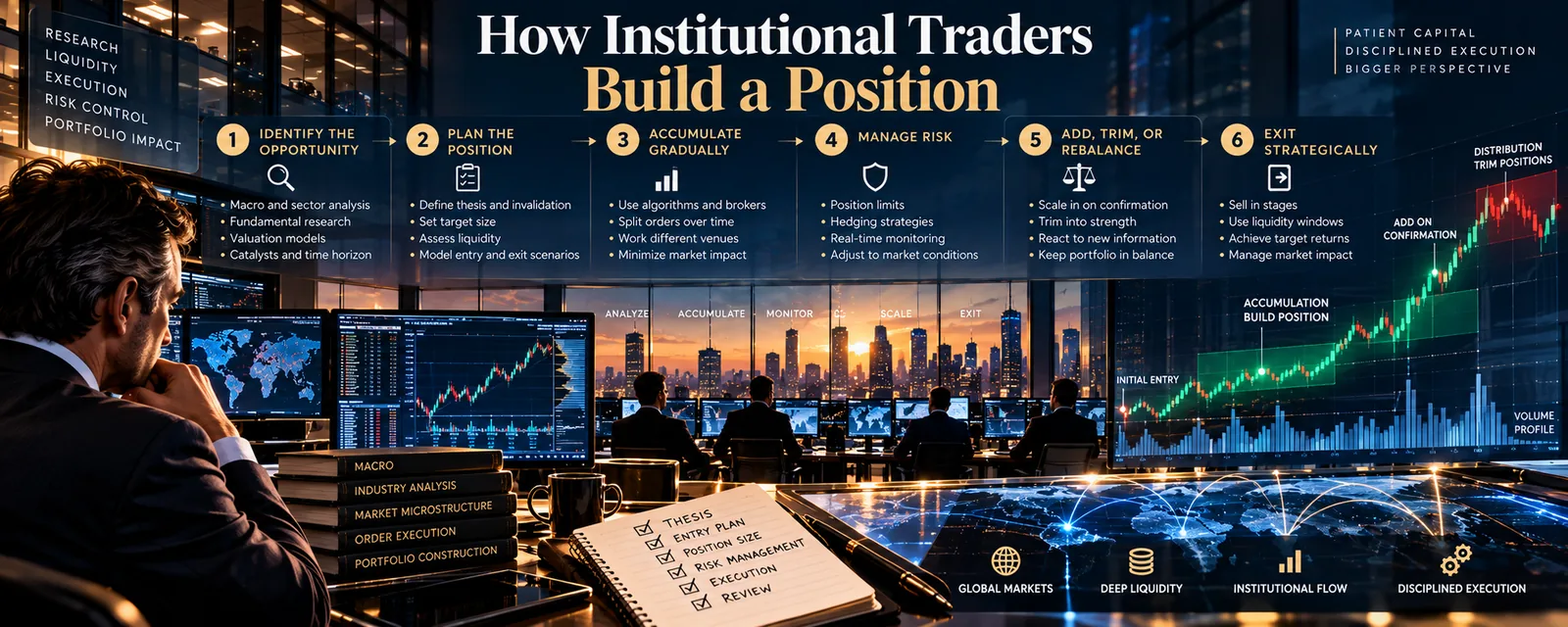 AnalysisEducationHow Institutional Traders Build a PositionFor a large order, entry is a sequence of decisions. Institutions often build positions in stages to manage market impact, timing uncertainty and the risk committed to an idea.@Abe6 min read
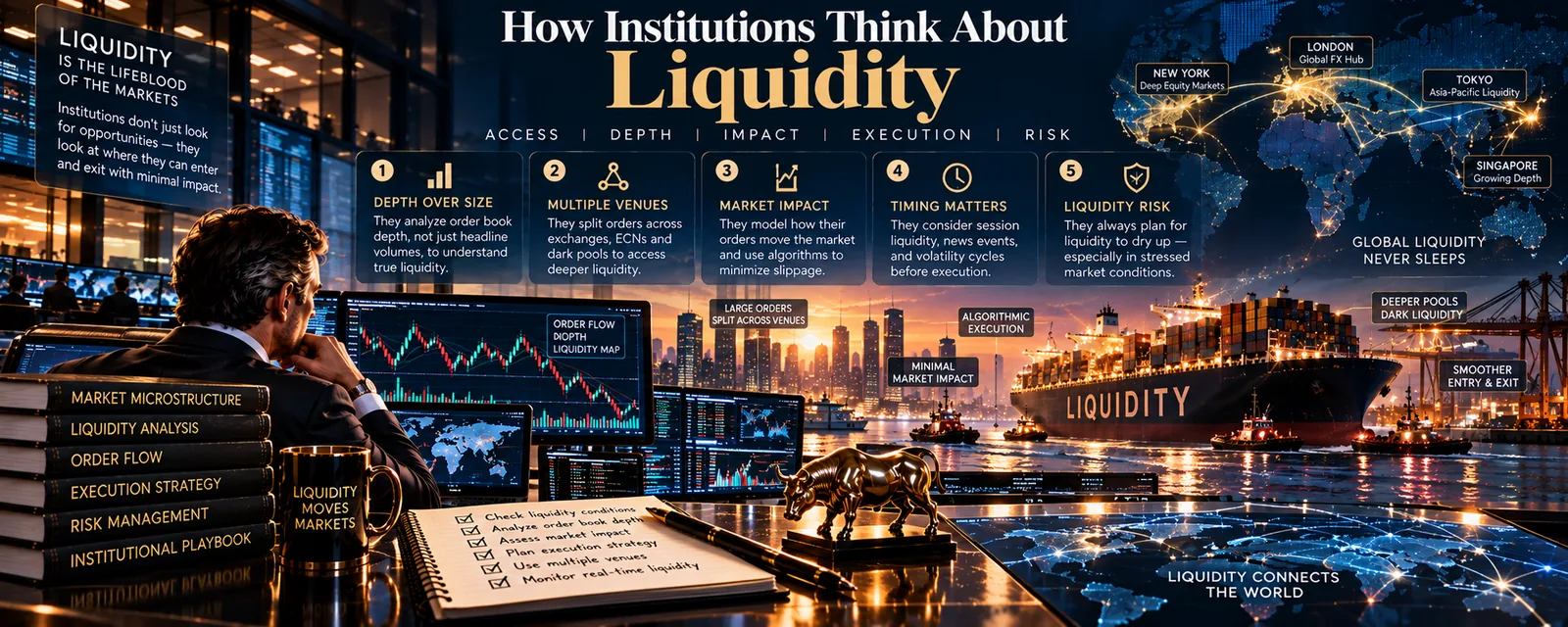 AnalysisEducationHow Institutions Think About LiquidityLiquidity is the price of getting something done. An institution asks how much it can trade, how quickly, and how far its own orders could move the market. The answer shapes both entry and exit.@Abe5 min read
A short note from a GIO4X desk, filed under Education. It explains; it does not forecast and it does not tell you to trade. GIO4X is a broker and earns money when clients trade.
Editorial standardshttps://www.gio4x.com/intelligence/blog/anatomy-of-an-institutional-trade
Printed from gio4x.com.