Part 13 of 15Institutional Trading
@AbePublished 6 min read

Fetching the page
Education · Analysis
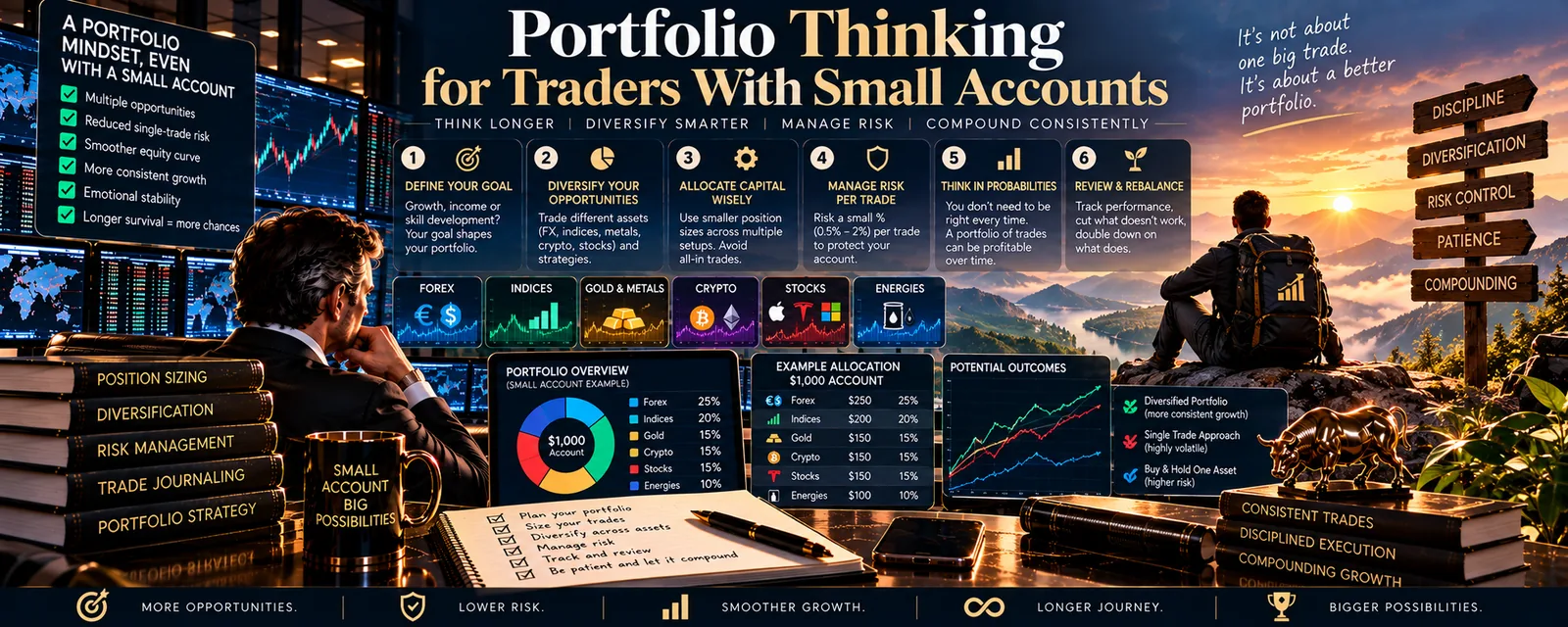
Five trades can still be one bet. Portfolio thinking asks what your positions would lose together, which drivers they share, and how much damage the whole account can absorb.
Part 13 of 15Institutional Trading
@AbePublished 6 min read
Position sizing, correlation and limits across the whole account
Five trades can still be one bet. Portfolio thinking asks what your positions would lose together, which drivers they share, and how much damage the whole account can absorb.
Desk insight. Manage three budgets together: risk per trade, risk per theme and total open risk.
Many traders assume the idea belongs to funds with fifty holdings. In fact, the moment you have two open positions you have a portfolio. The only question is whether you are managing it or just living in it.
A trader thinking trade by trade asks whether each position is good. A trader thinking in portfolios asks what happens to the account if everything open goes wrong on the same day.
The second question is the one that keeps accounts alive. Individual losses are survivable. Clustered losses are what cause the deep drawdowns that are hard to recover from.
The maths of recovery explains the concern. A loss needs a larger gain to undo it.
Rounded gains needed to recover a drawdown
| Drawdown | Gain needed to recover |
|---|---|
| 10% | 11% |
| 20% | 25% |
| 30% | 43% |
| 50% | 100% |
Suppose a trader with a 5,000 account risks 1 percent, or 50, on each of these positions.
Different positions with shared dollar exposure
| Position | Stated idea | What actually drives it |
|---|---|---|
| Long EUR/USD | Euro strength | Weaker US dollar |
| Long GBP/USD | Pound breakout | Weaker US dollar |
| Long AUD/USD | Commodity recovery | Weaker US dollar, risk appetite |
| Short USD/CHF | Range top | Weaker US dollar |
| Long gold | Trend continuation | Weaker US dollar, lower real yields |
The five positions carry a combined planned stop risk of 250, or 5 percent of the account, and share significant exposure to a weaker dollar. They are not identical bets, but a dollar rally could hurt them together. Gaps and slippage can push realised losses beyond the planned amount.
Nothing in the individual trade plans was wrong. The error only appears when the positions are viewed together.
Correlation measures how closely two markets move together. It is not a fixed property. It shifts with the market’s mood.
In some risk-off episodes, equities, commodity currencies and credit weaken together while perceived safe havens rise. The dollar and yen do not behave this way in every shock; the source of the stress matters.
So diversification that looks adequate on a quiet day can vanish in a crisis. Institutions plan for this by stress testing the whole book. A small trader can do a simple version by asking what a sudden risk-off move would do to every open position.
Most retail traders use a single rule: risk per trade. A portfolio approach adds two more.
These figures are examples, not recommendations. What matters is that all three exist and that the second and third are checked before each new trade.
With these rules, the five-trade example would have been capped at two positions, or run at smaller size on each.
Many traders use the same lot size for every trade. That gives very different risks, because stop distances and volatility differ.
The professional method fixes the money at risk and lets the size vary.
Position size in lots = (account equity × risk fraction) ÷ (stop distance × value per point per lot)
For a USD-denominated 5,000 account, 1 percent is 50 dollars. On EUR/USD, a 0.01 standard lot represents 1,000 euros and is worth about 0.10 dollars per pip. A 25-pip stop therefore risks 2.50 dollars per micro lot: 50 ÷ 2.50 = 20 micro lots, or 0.20 standard lots, before costs and slippage.
At a 50-pip stop, the same calculation gives 0.10 lots. The planned price loss stays at 50 dollars before costs and slippage. Contract specifications and account-currency conversion must be checked for other instruments.
Before adding a position, ask what it contributes.
Sometimes the best new trade is one that offsets part of the book. A position that tends to gain when the others lose can make the whole account steadier, even if it looks ordinary alone.
A small account need not hold thirty positions to diversify. Minimum trade sizes, costs and the chosen instruments determine what is practical; adding tickets alone does not reduce risk.
There are cheaper forms of spread.
A few positions with different drivers may diversify more effectively than ten expressions of one theme. Their relationships still need monitoring.
Institutions hold cash deliberately. It lowers total risk and keeps buying power for better opportunities.
For a small account, unused margin is the cushion that prevents forced closure. An account running near its margin limit has no room for an ordinary adverse move. Keeping most of the margin free is a risk decision, not a sign of timidity.
Leverage as a substitute for capital. High leverage makes a small account feel larger. It also makes normal volatility fatal.
Minimum size problems. If the smallest lot available puts more than your limit at risk, the trade is too big for the account. Skip it or find a smaller instrument.
Costs as a share of the account. Spreads, commissions and swaps weigh more heavily on a small balance. Fewer, better trades help.
The urge to grow quickly. Pursuing a doubling in one month can encourage exposure capable of causing a severe drawdown. A return target does not make that risk affordable.
Run this once a day and before each new trade.
A spreadsheet with four columns is enough. The discipline is in looking at it.
Key takeaway. Portfolio thinking is not about owning many things. It is about knowing what your positions have in common and capping the damage if that common factor turns.
Start with three limits: per trade, per theme and across the account. A short daily review can reveal concentration before a bad afternoon exposes it.
Part 13 of 15 in the series Institutional Trading. Next: What Retail Traders Can Copy From Hedge Funds, and What They Cannot.
Independent educational commentary, not investment advice. References to firms do not imply affiliation or endorsement. Figures in examples illustrate a method, not a recommended allocation or a promised outcome. Trading leveraged products carries a high risk of loss.
 AnalysisEducationStanley Druckenmiller: Bet Big Only When the Stars AlignStanley Druckenmiller ran Duquesne Capital for about three decades, averaged roughly 30% a year and never had a losing year. He did it by breaking a rule most investors treat as sacred. He did not diversify. He concentrated, but only on rare occasions.@Abe2 min read
 AnalysisEducationWhat Hedge Funds See That Retail Traders Usually MissThe chart shows price. A hedge fund also asks who holds the trade, what it costs to carry, and which other positions would lose alongside it. That wider view can change a decision before the first order is sent.@Abe5 min read
 AnalysisEducationTrade Like a Desk, Not Like a GamblerThe same entry can belong to a disciplined trading business or an impulsive bet. The difference sits around the order: a mandate, a repeatable setup, a risk budget and an honest review.@Abe5 min read
A short note from a GIO4X desk, filed under Education. It explains; it does not forecast and it does not tell you to trade. GIO4X is a broker and earns money when clients trade.
Editorial standardshttps://www.gio4x.com/intelligence/blog/portfolio-thinking-for-small-accounts
Printed from gio4x.com.