Part 14 of 15Institutional Trading
@AbePublished 6 min read

Fetching the page
Education · Analysis
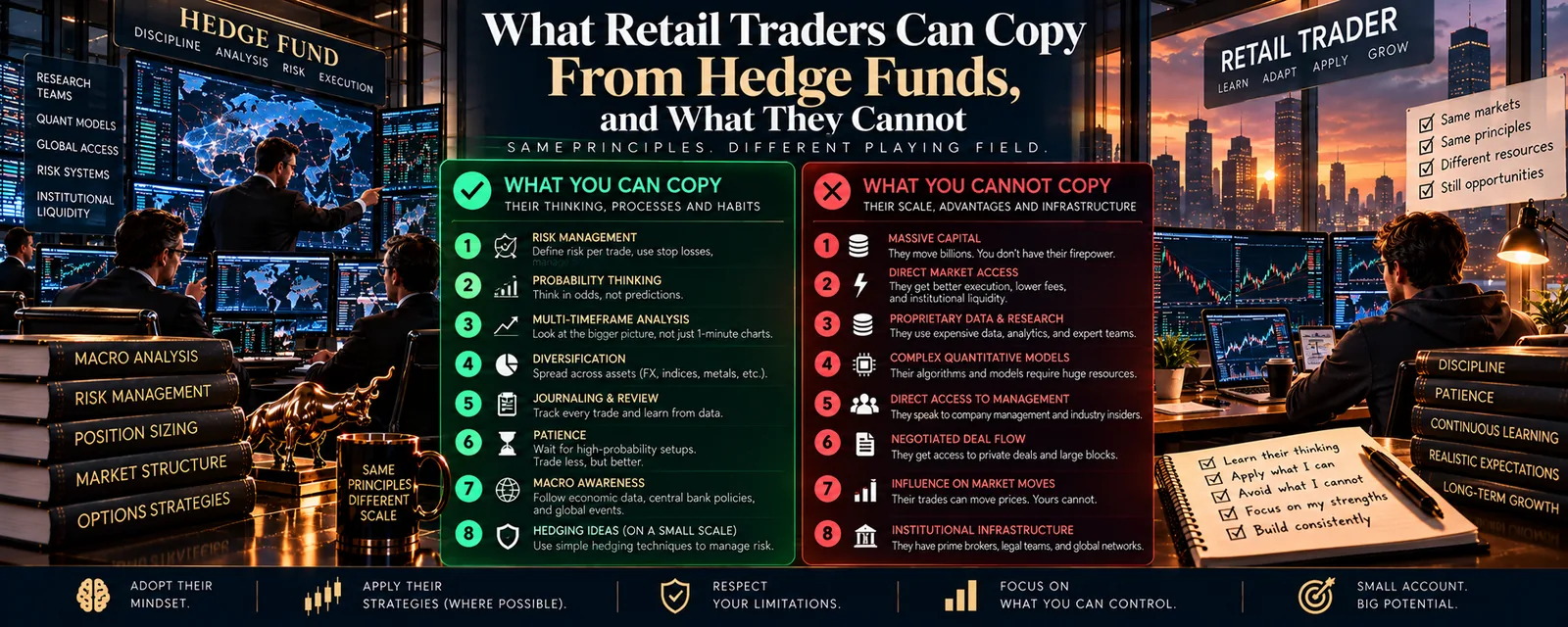
Hedge-fund discipline is more transferable than hedge-fund infrastructure. A retail trader can adopt written decisions, risk budgets and reviews while recognising the limits of access, financing, instruments and execution.
Part 14 of 15Institutional Trading
@AbePublished 6 min read
Transferable discipline and the limits of institutional imitation
Hedge-fund discipline is more transferable than hedge-fund infrastructure. A retail trader can adopt written decisions, risk budgets and reviews while recognising the limits of access, financing, instruments and execution.
Desk insight. Copy risk discipline and honest review. Choose strategies that fit your own costs and resources.
Much trading education blurs the line. It promises to teach you to “trade like the smart money” by reading a chart pattern. The chart is the least important part of what a fund does.
A fund sets the acceptable loss before discussing the potential gain. Position size follows from that loss and the stop distance.
This needs no capital and no technology. It needs a calculator and the willingness to accept the answer.
Funds document their strategies, their entry criteria and their exit rules. The purpose is consistency. A written rule can be checked. A feeling cannot.
A one-page trading plan does the same job. Two setups, clear conditions, fixed risk, defined exits.
Funds measure exposure by underlying driver, not by ticket count. They know when five positions are one bet.
Any trader can label each open position by what moves it and cap the total per driver.
Daily loss limits and drawdown limits are standard on professional desks. They stop trading when judgment is most impaired.
You can set the same limits. The difficulty is that you are also the person who must enforce them.
Funds evaluate strategies over many trades and judge decisions separately from outcomes. A loss that followed the plan is acceptable. A win that broke it is a problem.
This is a habit of mind. It is free, though not easy.
Every fund analyses its own performance: by strategy, by market, by time. Many discover that a small part of what they do earns most of the profit.
A journal and a monthly review give you the same view of yourself.
Professionals compare their view with market expectations. Only the difference is a trade.
Implied rate expectations, consensus forecasts and positioning data are publicly available for major markets.
A fund reviews many ideas and trades few. Passing is normal.
A retail trader can pass even more freely, with no investors asking why the fund is in cash.
Large funds speak to company executives, policymakers’ former advisers and industry experts. They buy data on shipping, card spending, satellite images and web traffic. They receive research and flow colour from several banks.
A retail trader reading public news is seeing information the market has usually already absorbed. Trading as though you have an informational edge when you do not is expensive.
Specialised quantitative firms invest in co-located servers, low-latency networks and automated processing. Their infrastructure can react at speeds a manual home setup cannot match.
No home setup competes on this ground. Strategies that depend on being first should be left to firms built for it.
Large funds may negotiate financing, securities borrowing and portfolio-margin terms through prime brokers. Access and cost depend on collateral, strategy and market conditions; borrowing stock is never unlimited.
Retail leverage looks generous, but it comes with wider costs, overnight charges and automatic liquidation. It is a different product.
Institutions trade swaps, structured options, credit derivatives and private deals. These let them isolate a precise view, such as the gap between two interest rates, without unwanted exposure.
Retail traders mostly have access to spot, CFDs, listed futures and simple options. The same idea often has to be expressed more crudely.
Large funds may negotiate lower unit commissions and spreads, but market impact can offset that advantage. A very small gross edge that survives one firm's costs may be unprofitable at another trader's costs.
This rules out many high-frequency and scalping approaches for small accounts, whatever the backtest shows.
A fund separates research, portfolio management, execution, risk and operations. Each has specialists who check one another.
A solo trader does all five jobs, usually in the same hour, usually while watching the position.
A multi-strategy fund can combine many positions and sources of return. Offsetting exposures may smooth results, but leverage and shared risks can still produce abrupt drawdowns.
A small account can hold a handful of positions. Its results will be lumpier, and it should size accordingly.
Lock-ups and stable investors may reduce redemption pressure, while fees can support operating costs. Funding terms, investor demands and risk limits can still force action during a drawdown.
A trader who needs the account for living expenses does not have that luxury, and should not behave as though they do.
Which institutional practices transfer
| Area | Can a retail trader copy it? | Note |
|---|---|---|
| Risk-first sizing | Yes | Needs discipline only |
| Written plan | Yes | One page is enough |
| Portfolio view of exposure | Yes | Label positions by driver |
| Loss limits | Yes | Use platform or broker limits if offered |
| Trade review | Yes | Journal plus monthly review |
| Specialist information and access | Limited | Public sources remain useful; do not assume an information edge |
| Execution speed | No | Avoid speed-based strategies |
| Cheap financing and shorting | No | Count overnight costs |
| Complex instruments | Mostly no | Use the simplest clean expression |
| Institutional trading costs | No | Avoid strategies with tiny per-trade edge |
The comparison is not all one way. Size is a burden as well as a strength.
The sensible strategy follows from this. Compete where smallness helps: patience, selectivity, flexibility and longer holding periods. Avoid contests decided by speed, data or cost.
Some content claims to reveal where institutions are buying, based on chart patterns alone. Treat it with care.
Funds do leave footprints, and understanding liquidity is useful. But no chart shows who is trading or why. A method that claims certainty about institutional intent is selling a story.
Professional status does not guarantee strong performance. Hedge funds can underperform or close, and comparisons depend on strategy, benchmark, period and fees. Copy a defensible process rather than assuming the label implies an edge.
Key takeaway. The parts of hedge fund practice that protect capital are available to everyone: risk first, written rules, portfolio awareness, limits and review. The parts that generate their specific edges are not.
Adopt the practices you can implement and test. Competing on resources you do not possess is a poor substitute for a process you can control.
Part 14 of 15 in the series Institutional Trading. Next: Why Risk Managers Sometimes Have More Power Than Traders.
Independent educational commentary, not investment advice. References to firms do not imply affiliation or endorsement. Figures in examples illustrate a method, not a recommended allocation or a promised outcome. Trading leveraged products carries a high risk of loss.
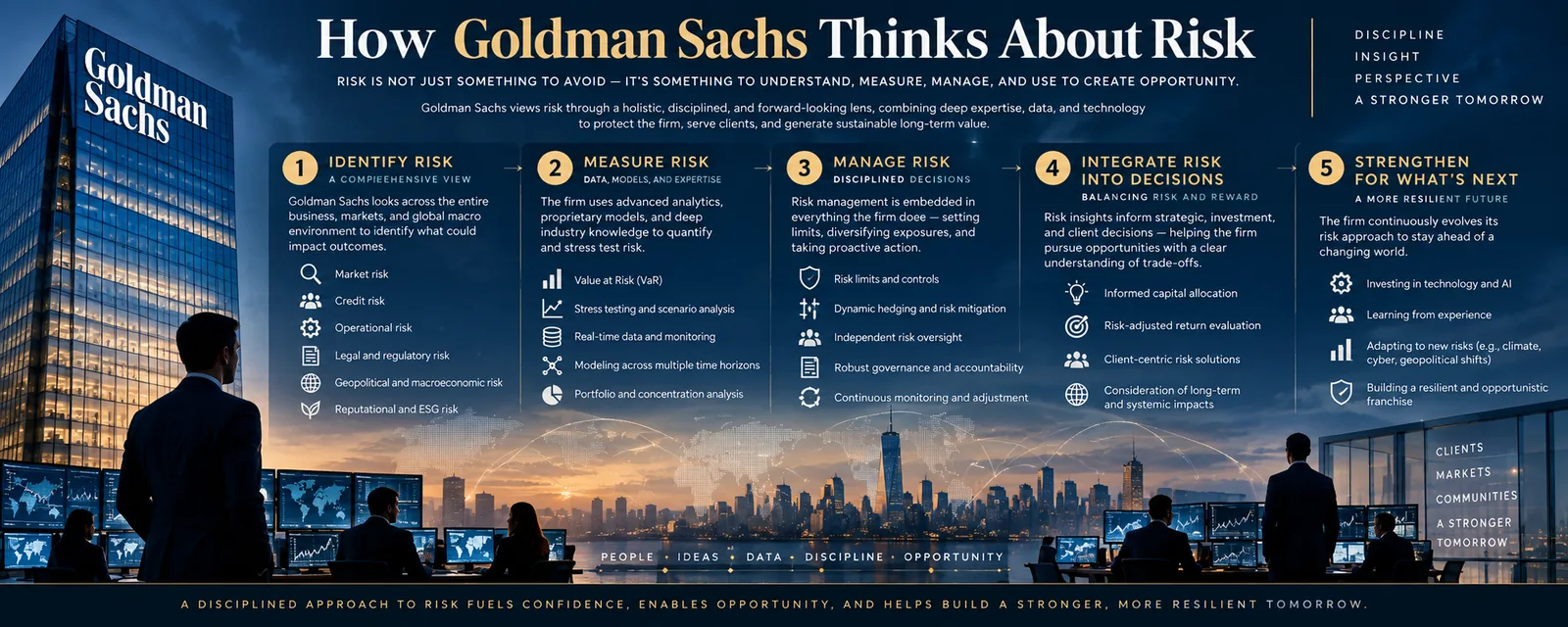 AnalysisEducationHow Goldman Sachs Thinks About RiskThe first question in institutional trading is how much can be lost, how quickly, and who will act. Goldman Sachs offers a useful lens on that discipline: risk is measured, challenged and escalated throughout the life of a position.@Abe5 min read
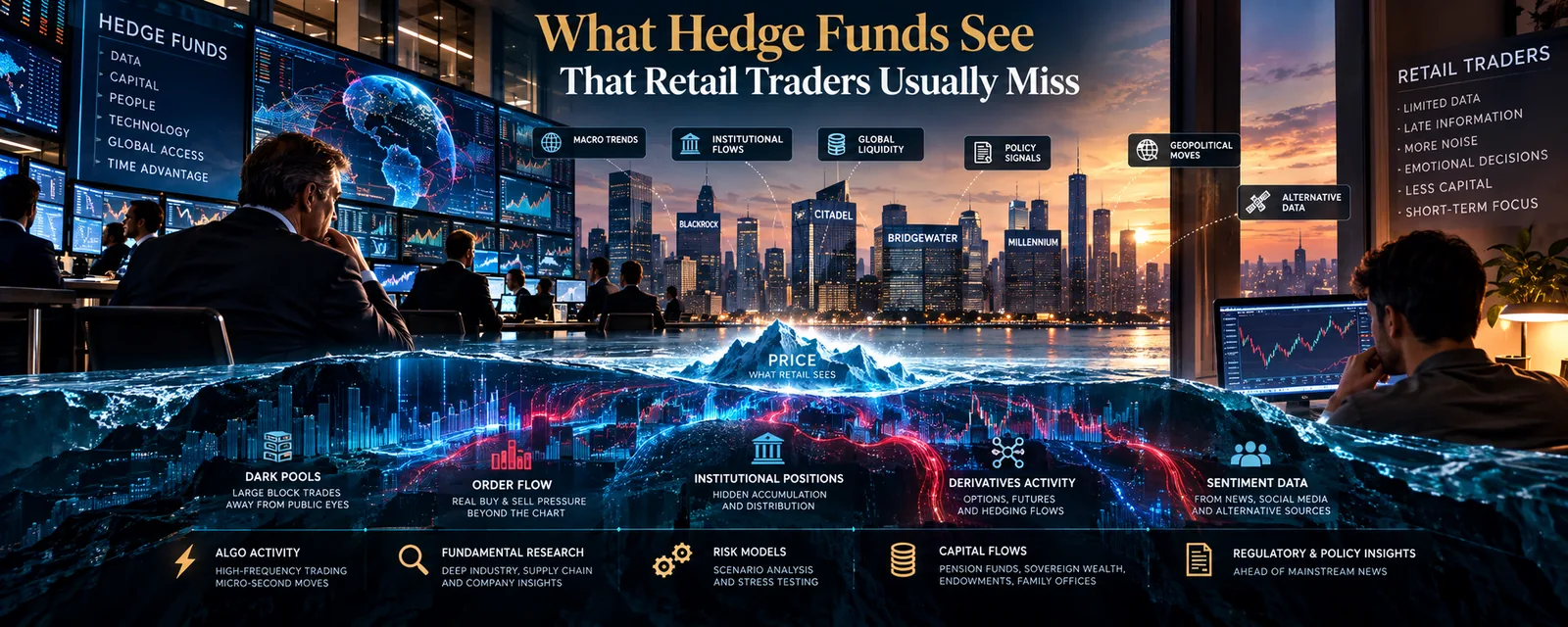 AnalysisEducationWhat Hedge Funds See That Retail Traders Usually MissThe chart shows price. A hedge fund also asks who holds the trade, what it costs to carry, and which other positions would lose alongside it. That wider view can change a decision before the first order is sent.@Abe5 min read
 AnalysisEducationTrade Like a Desk, Not Like a GamblerThe same entry can belong to a disciplined trading business or an impulsive bet. The difference sits around the order: a mandate, a repeatable setup, a risk budget and an honest review.@Abe5 min read