Part 2 of 20The Future of Trading
@AbePublished 3 min read

Fetching the page
Education · Analysis
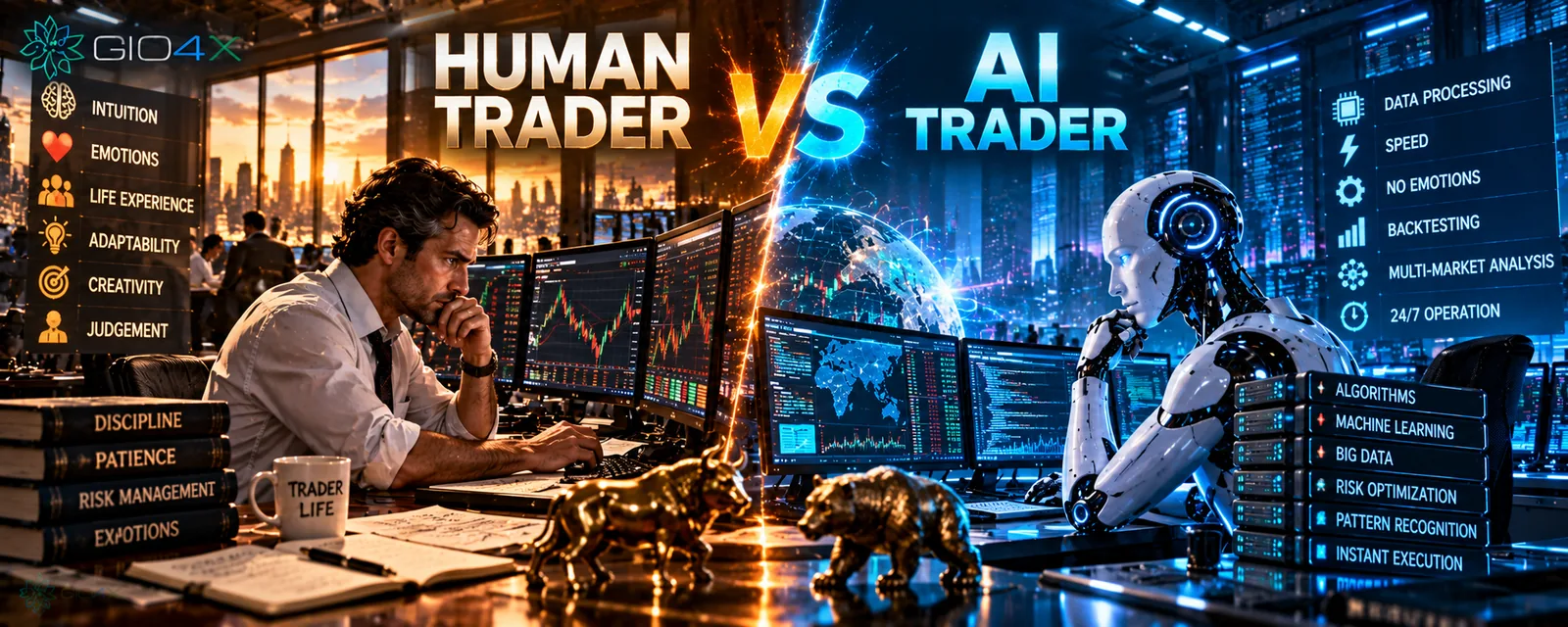
A machine can watch thousands of markets without blinking. A human can recognise that the assumptions behind its signals have broken. Speed, breadth and consistency favour AI; context and unfamiliar situations still leave room for judgment. Your trading edge determines which strengths you need.
Part 2 of 20The Future of Trading
@AbePublished 3 min read
Where people and machines have the edge
A machine can watch thousands of markets without blinking. A human can recognise that the assumptions behind its signals have broken. Speed, breadth and consistency favour AI; context and unfamiliar situations still leave room for judgment. Your trading edge determines which strengths you need.
Key takeaway. Automate rules that can be tested. Keep objectives, risk budgets and decisions about unfamiliar situations under human supervision.
| Dimension | Human trader | AI trader |
|---|---|---|
| Reaction time | 200 milliseconds at best | Microseconds |
| Instruments watched | A handful | Thousands at once |
| Discipline | Varies with sleep, mood and last trade | Identical on every trade |
| Learning from small samples | Strong; one event can teach a lesson | Weak; needs many examples |
| Handling unseen events | Can reason from first principles | Extrapolates from training data |
| Explaining a decision | Natural, if sometimes rationalised | Often opaque |
| Cost to scale | Linear; more traders, more salary | Near zero per extra market |
| Failure mode | Slow, emotional, visible | Fast, silent, correlated |
Speed. A human blink takes about 300 milliseconds. A co-located system can receive a quote, decide and respond thousands of times in that window. Any strategy that depends on being first belongs to machines.
Breadth. A discretionary trader follows perhaps ten markets well. A model can scan every listed stock, currency pair and futures contract for the same pattern, every second, without fatigue.
Consistency. Humans cut winners early and hold losers too long. Behavioural finance has documented this for forty years, and knowing about it does not cure it. A system takes the hundredth signal exactly as it took the first.
Context. A trader reading a central bank statement knows the governor is under political pressure, that the previous meeting was contentious, and that the market is positioned one way. Language models are narrowing this gap, but they still miss what was never written down.
Novelty. In January 2015 the Swiss National Bank removed its euro floor without warning. EUR/CHF fell around 20 percent in minutes. No backtest contained that day. Humans who had asked "what if the peg breaks?" were positioned for it; models trained on three years of a flat line were not.
Knowing when to stop. A good trader senses when a strategy has stopped working before the statistics confirm it. A model keeps trading until its risk limit is hit.
Human errors are usually slow and isolated. One trader tilts, oversizes and blows up one account.
Machine errors are fast and shared. In the May 2010 Flash Crash, US equity indices fell roughly 9 percent and recovered within about half an hour as automated liquidity withdrew at once. When many systems learn from the same data, they tend to exit through the same door.
Neither failure mode is safer. They need different controls: psychology and position limits for people, kill switches and diversity of models for machines.
After Garry Kasparov lost to Deep Blue in 1997, chess experimented with human-plus-computer teams, nicknamed centaurs. For some years, a competent human with a good engine beat both grandmasters and engines alone.
That advantage eventually faded in chess as engines improved. Markets are different in one important way: the rules of chess never change, while markets are rewritten by policy, technology and the players themselves. That keeps the human contribution alive for longer.
In practice, the best-performing setups today combine the two. The machine generates signals, sizes positions and executes. The human sets objectives, approves the risk budget and holds the off switch.
A simple rule helps. If your edge can be written as a precise rule and tested on data, a machine will run it better than you. Automate it, or accept that someone else has.
If your edge depends on interpreting a situation with few precedents, keep the decision discretionary, trade smaller and use AI as an assistant. Match the work to the strongest capability: machine consistency for repeatable tasks, human judgment when the assumptions need questioning.
Part 2 of 20 in the series The Future of Trading. Next: Can LLMs Understand Financial Markets?.
General information, not investment advice. Unlinked figures are approximate.
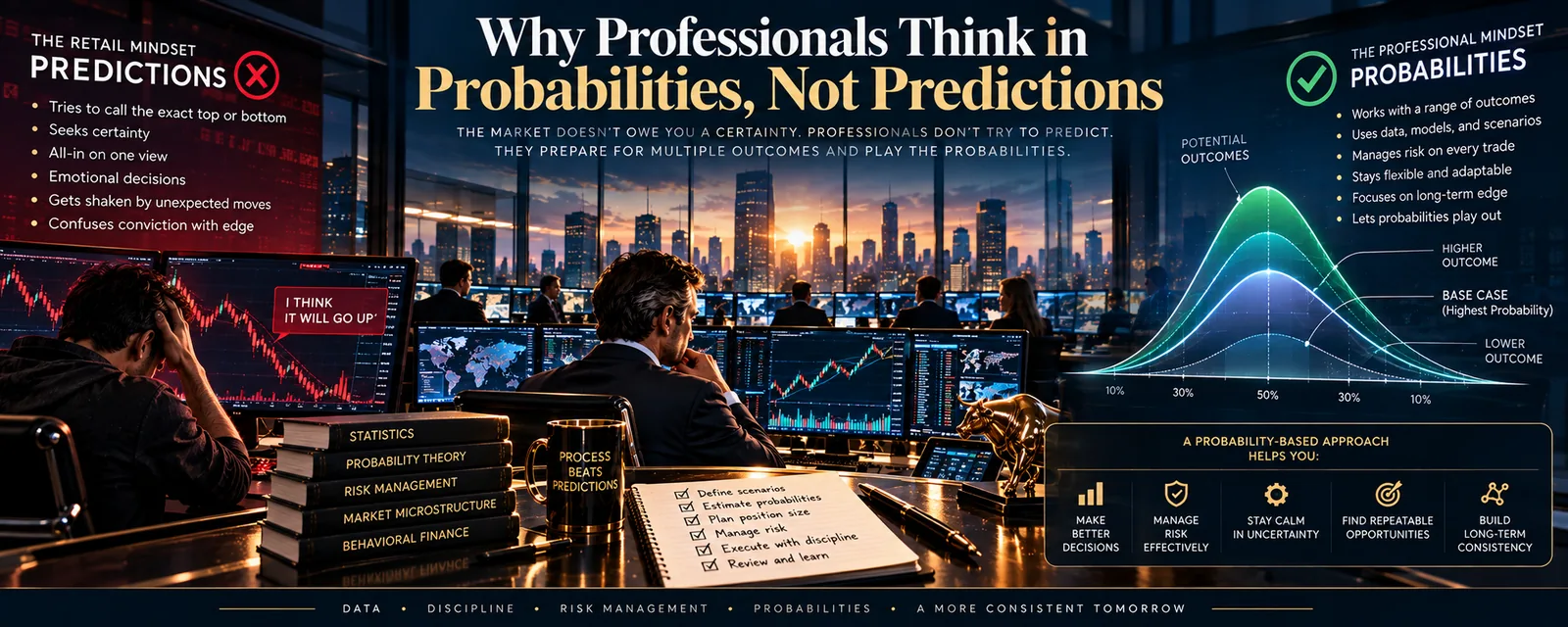 AnalysisEducationWhy Professionals Think in Probabilities, Not PredictionsA trade does not need to win most of the time to have positive expected value. It needs a payoff that compensates for its probability of loss, and position sizing that can withstand an unfavourable run.@Abe6 min read
 AnalysisEducationWhat Happens When AIs Trade Against Other AIs?Machines have been trading against machines for more than a decade. The result is familiar: tighter spreads, fewer simple opportunities and failures that can unfold at extraordinary speed. Learning systems add a harder question—what happens when those machines adapt to one another?@Abe4 min read
 AnalysisEducationWill AI Replace Traders?AI is taking over the work traders do with their hands far faster than the work they do with their judgment. Execution and routine analysis are increasingly automated. Deciding what risks to take—and owning the consequences—remains a human responsibility.@Abe3 min read
https://www.gio4x.com/intelligence/blog/human-trader-vs-ai-trader
Printed from gio4x.com.