Part 1 of 20The Future of Trading
@AbePublished 3 min read

Fetching the page
Education · Analysis
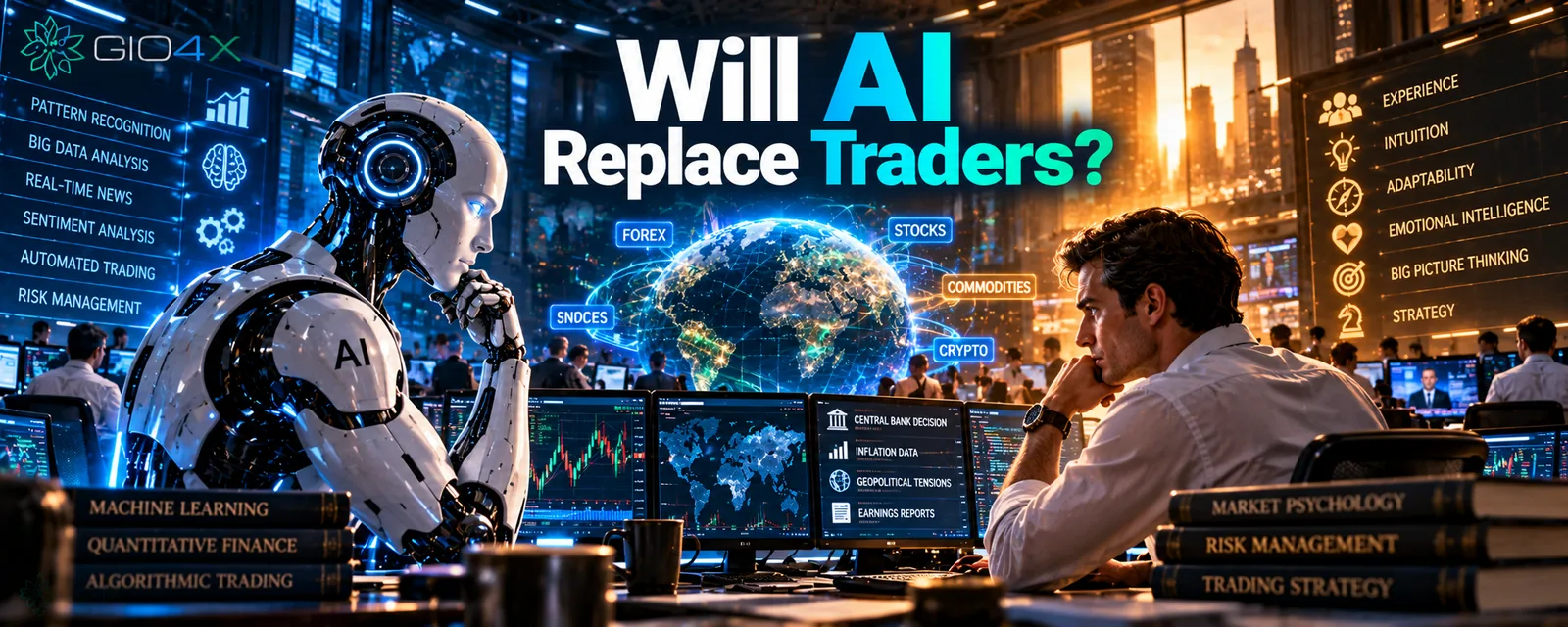
AI is taking over the work traders do with their hands far faster than the work they do with their judgment. Execution and routine analysis are increasingly automated. Deciding what risks to take—and owning the consequences—remains a human responsibility.
Part 1 of 20The Future of Trading
@AbePublished 3 min read
AI and the changing trading career
AI is taking over the work traders do with their hands far faster than the work they do with their judgment. Execution and routine analysis are increasingly automated. Deciding what risks to take—and owning the consequences—remains a human responsibility.
Key takeaway. AI replaces tasks. The more a role depends on routine execution and analysis, the more exposed it is; judgment, risk ownership and client trust remain valuable.
The question sounds new, but the first wave ended years ago. In 2000, Goldman Sachs employed roughly 600 cash equities traders in New York. By 2017 the firm said two remained, supported by automated systems and a few hundred engineers.
Nobody called those systems artificial intelligence. They were execution algorithms, smart order routers and market-making engines. Yet they removed the most visible trading job of the twentieth century: the person who shouts or clicks an order into the market.
Today, algorithms handle well over half of US equity volume by most estimates, and a growing share of spot FX. The human who manually works a large order is now the exception.
The first wave automated execution. The current wave, built on machine learning and large language models, is automating analysis.
A model can read every earnings transcript published overnight, summarise central bank speeches, flag unusual options flow and draft a trade idea before a junior analyst has opened a spreadsheet. Work that filled the first three years of a trading career is now a prompt.
This matters because the junior work was also the training ground. Firms that cut it entirely will have to find another way to produce senior traders.
Three parts of trading resist automation.
The roles under most pressure are those built on speed of information or speed of fingers. Manual scalping against machines is already a losing contest. Routine sell-side execution, basic technical analysis and templated research are close behind.
The roles that grow sit one level up. Someone has to design strategies, supervise models, set risk limits and intervene when behaviour looks wrong. Knight Capital lost about $440 million in 45 minutes in 2012 because faulty code ran with nobody able to stop it quickly. The lesson firms drew was to add better supervision, not to remove humans.
The trader of the next decade looks less like a pilot flying by hand and more like an air traffic controller. Fewer people, more leverage per person, and a far higher cost of a mistake.
Retail traders are in an odd position. They are not employees, so nobody can replace them. But they compete in the same market as the machines.
The practical consequences are clear. Short-horizon edges based on reacting to news are gone, because machines read the headline first. Edges based on patience, small size and freedom from benchmarks remain, because institutions cannot use them.
AI also lowers the cost of tools that once required a quant team. Backtesting, coding an expert advisor and screening thousands of instruments are now within reach of one person with a laptop.
AI replaces tasks, and a job is a bundle of tasks. Where the bundle is mostly execution and routine analysis, the job disappears. Where it is mostly judgment, risk ownership and client trust, the job changes shape and becomes more productive.
Traders will not vanish, but the job will become more demanding. Fewer people will oversee more capital, with more of their day spent supervising machines. The pressure on a trader who refuses AI will come from another trader who uses it well.
Part 1 of 20 in the series The Future of Trading. Next: Human Trader versus AI Trader.
General information, not investment advice. Unlinked figures are approximate.
 AnalysisEducationWhat Happens When AIs Trade Against Other AIs?Machines have been trading against machines for more than a decade. The result is familiar: tighter spreads, fewer simple opportunities and failures that can unfold at extraordinary speed. Learning systems add a harder question—what happens when those machines adapt to one another?@Abe4 min read
 AnalysisEducationHuman Trader versus AI TraderA machine can watch thousands of markets without blinking. A human can recognise that the assumptions behind its signals have broken. Speed, breadth and consistency favour AI; context and unfamiliar situations still leave room for judgment. Your trading edge determines which strengths you need.@Abe3 min read
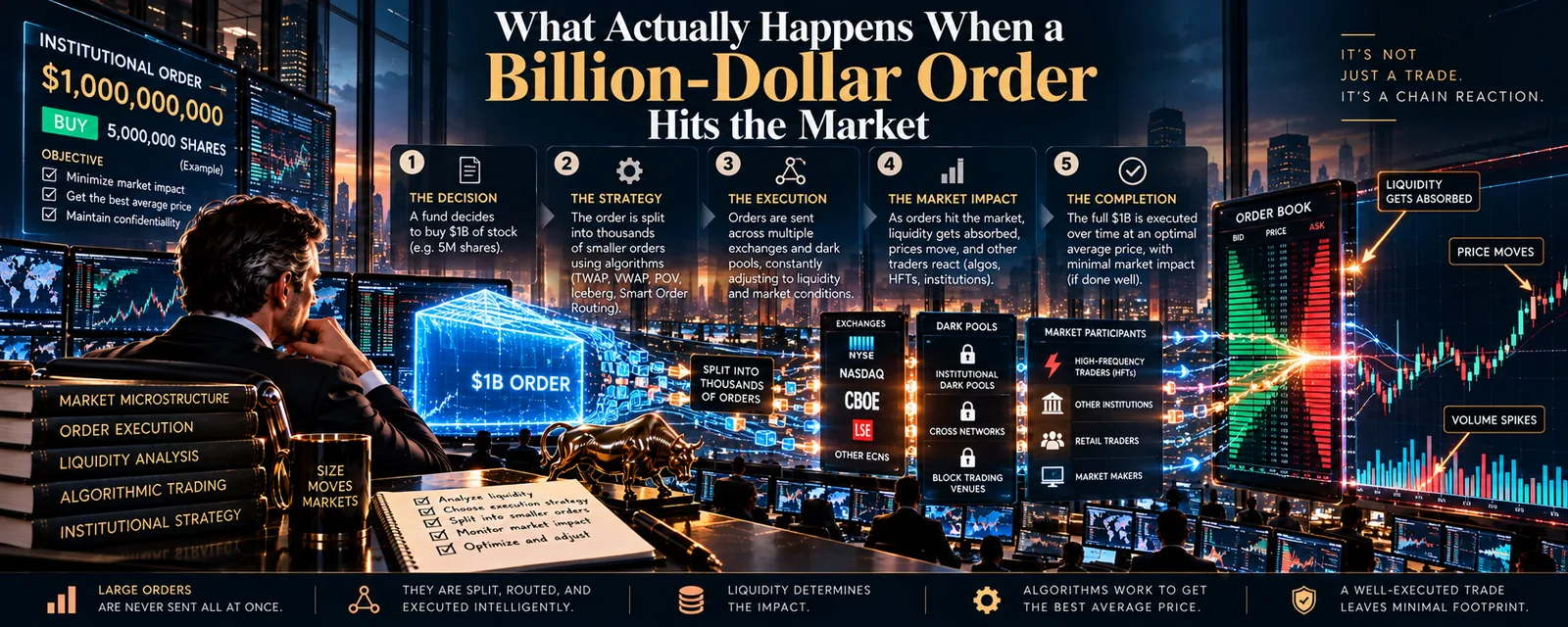 AnalysisEducationWhat Actually Happens When a Billion-Dollar Order Hits the MarketA billion-dollar equity order can become a project lasting several sessions. The execution desk divides the instruction, finds counterparties and balances speed against market impact. The route depends on liquidity and urgency.@Abe6 min read
https://www.gio4x.com/intelligence/blog/will-ai-replace-traders
Printed from gio4x.com.