Part 2 of 15The History of Trading
@AbePublished 4 min read

Fetching the page
Education · Explainer
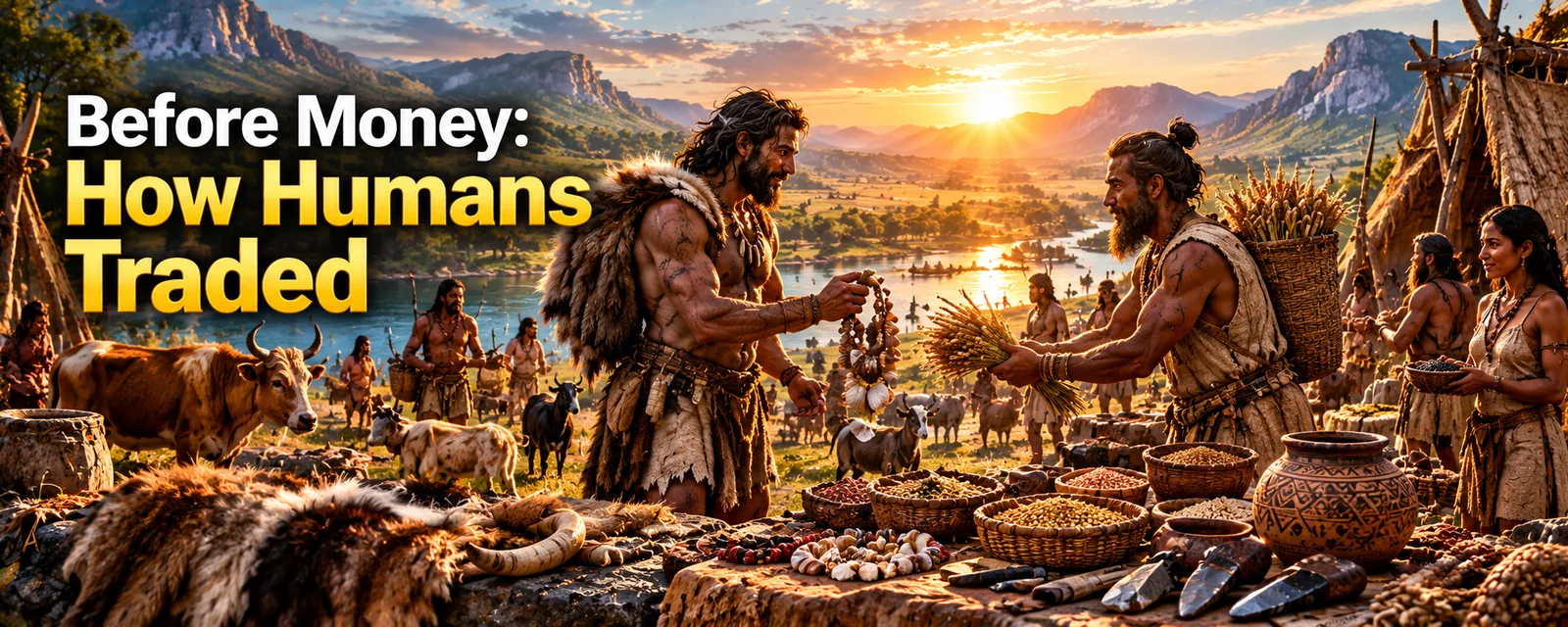
The familiar story begins with awkward barter and ends with the invention of money. Human communities were more inventive than that, using obligations, shared measures and remembered debts to keep exchange moving.
Part 2 of 15The History of Trading
@AbePublished 4 min read
You have grain. Your neighbour has a goat. You want the goat, but your neighbour has enough grain already.
The textbook solution arrives in a neat sequence: barter becomes inconvenient, somebody invents money, and the problem disappears.
It is a useful classroom example. As a universal account of how money began, it is much less convincing. Human communities did not all pass through a clearly documented stage in which every transaction required an immediate swap.
To understand trading before money, we need to make room for something less visible than a coin: an obligation.
Economists call the barter problem the double coincidence of wants. Each party must want what the other offers, at the same time, and in quantities both can accept.
The problem is real. Suppose the goat is worth more than the grain you need today. You cannot conveniently divide a living goat into small payments. Waiting for a perfectly matched exchange may mean waiting a long time.
But communities had another possibility. If people expected to see one another again, an exchange did not always have to end with both sides fully paid. Something could be given now and returned later.
That is the essential opening for credit. The transaction reaches into the future.
Gifts, favours and obligations helped people exchange within relationships. A neighbour might receive help at one moment and provide something in return at another. The terms could be social and flexible rather than expressed as a precise money price.
Such arrangements should not be romanticised. An obligation can bind people together, but it can also create pressure and dependence. Credit is not automatically generous merely because no coins change hands.
Nor did barter vanish. Direct exchange could be useful between people without established credit relationships, as well as in other circumstances. The point is that barter, credit and gifts could coexist. They were not necessarily consecutive steps on one ladder.
🔎 Did You Know? The difficulty of finding a perfect barter match explains why a common medium of exchange is useful. It does not, by itself, prove that every society originally operated through barter.
As exchange became more complex, people needed ways to compare and record obligations. In Mesopotamia, barley and weighed silver provided important measures of value.
The shekel began as a unit of weight, not as a minted coin. That distinction matters. A society can state an amount owed in a recognised unit without passing a matching coin across a table.
Clay tablets recorded who owed what to whom. Debt could therefore be documented long before coinage. Writing made an obligation more durable than an individual's memory, although recording a debt was not the same as guaranteeing repayment.
This separates three ideas that are easily bundled together: the unit used to express a price, the thing used to make a payment, and the record showing that a payment is due.
🧭 Why This Matters to Traders: A balance, a settlement and an asset are different things. Knowing what an account records is essential to understanding what you actually own or owe.
Across different societies and periods, cowrie shells, salt, cattle and cacao beans served monetary roles. There was no single material destined to become money everywhere.
Local conditions mattered. Recognition, availability and accepted uses could make an object suitable for exchange. Durability and difficulty of imitation could help, but no simple checklist explains every historical example.
The limestone discs associated with Yap make the social element especially vivid. Ownership could change without the stone itself moving. People could recognise a change of title while the physical object stayed where it was.
That is not a claim that Yap invented digital money. It is a reminder that transferring recognised ownership and physically moving an object are different acts.
The recurring problem was how to make claims intelligible and acceptable to other people. A remembered favour, an inscription on clay and a recognised stone all offer different answers.
🎯 Trader Takeaway: Ask who recognises an obligation, how it is recorded and how it is settled. A number becomes useful only when the surrounding system gives it meaning.
Money's history is therefore richer than a tale about escaping inconvenient goat swaps. It is also a history of people deciding what counts as payment, what can be owed and whose record will be believed.
Before money could fit in a pocket, it already existed in relationships.
Part 2 of 15 in the series The History of Trading. Next: How Coins Changed Civilization.
 ExplainerEducationThe First Trade in Human HistoryLong before coins, contracts or candlestick charts, volcanic glass was travelling across ancient landscapes. The first chapter in our trading story begins with a sharp edge and a question of trust.@Abe4 min read
 AnalysisEducationHow Goldman Sachs Thinks About RiskThe first question in institutional trading is how much can be lost, how quickly, and who will act. Goldman Sachs offers a useful lens on that discipline: risk is measured, challenged and escalated throughout the life of a position.@Abe5 min read
 AnalysisEducationWhat Hedge Funds See That Retail Traders Usually MissThe chart shows price. A hedge fund also asks who holds the trade, what it costs to carry, and which other positions would lose alongside it. That wider view can change a decision before the first order is sent.@Abe5 min read
https://www.gio4x.com/intelligence/blog/before-money-how-humans-traded
Printed from gio4x.com.