Part 7 of 20The Future of Trading
@AbePublished 4 min read

Fetching the page
Education · Analysis
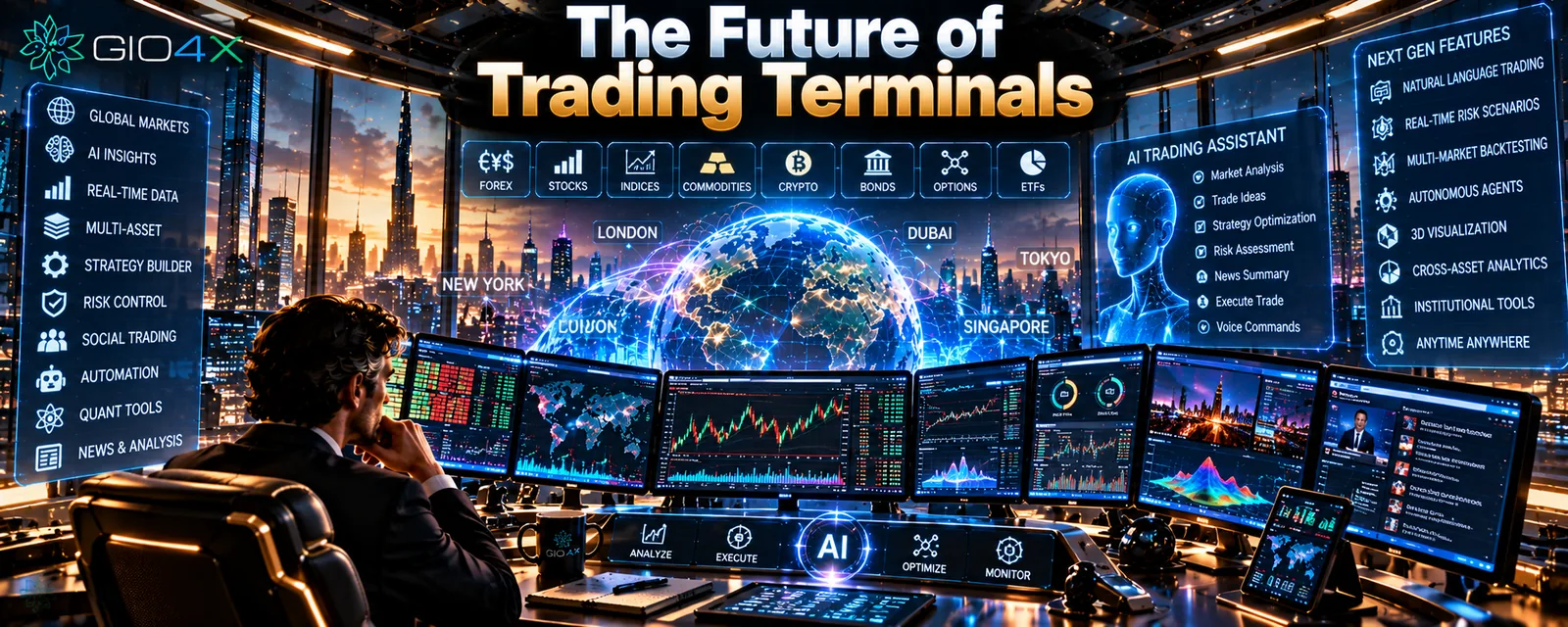
The next trading terminal will begin with a request, not a menu. Charts, order tickets and news feeds will remain, but software will assemble them around what the trader wants to do. The terminal is becoming an assistant you brief.
Part 7 of 20The Future of Trading
@AbePublished 4 min read
The terminal becomes a research assistant
The next trading terminal will begin with a request, not a menu. Charts, order tickets and news feeds will remain, but software will assemble them around what the trader wants to do. The terminal is becoming an assistant you brief.
Key takeaway. A better interface is useful only when the data, execution and controls are reliable. Demand sources, hard limits and the ability to take your work elsewhere.
The modern terminal dates from 1982, when Bloomberg installed its first machines at Merrill Lynch. It bundled data, analytics and messaging into one box with its own keyboard, and it still defines the category.
The second era was the downloadable platform. MetaTrader 4 arrived in 2005 and gave retail forex traders charts, indicators and automated strategies for free. The third was the browser and the phone: TradingView put professional-grade charting on a web page, and brokers put the order ticket in an app.
Each era widened access and lowered cost. None changed the basic interaction. The trader still hunts through menus, arranges panels and types commands.
A professional terminal offers tens of thousands of functions. Most users rely on a few dozen. The rest are hidden behind codes and menus learned by apprenticeship.
Retail platforms have the opposite problem. They are simple, but the trader's workflow is scattered: charts in one tab, news in another, a calendar in a third, a spreadsheet for the journal.
In both cases the human is the integration layer. That is the work software is about to take over.
The first change is the interface. You state what you want in plain language and the terminal builds it.
"Show me EUR/USD against the two-year yield spread since January, and mark every ECB meeting." Today that takes several minutes and some skill. With a language model driving the terminal, it takes one sentence.
Every major vendor is building this. The command line was the fast path for experts; natural language makes the same path available to everyone.
A conventional terminal waits to be asked. The next one watches on your behalf.
It knows your positions, your watchlist and your stated rules. It tells you that a holding reports earnings tomorrow, that your exposure to the dollar has crept above your limit, or that a pattern you trade has appeared on an instrument you were not watching.
The risk is noise. A terminal that alerts constantly is worse than one that is silent. The winners will be those that learn what each user actually acts on.
Today an idea passes through separate tools: a chart to spot it, a script editor to code it, a backtester to test it, a platform to trade it.
In an AI-native terminal this is one conversation. Describe the idea, have the system code it, see the backtest with costs included, adjust, and deploy with limits. The time from thought to tested strategy falls from days to minutes.
This also raises the danger of overfitting. When testing a hundred variations is effortless, finding one that looked good by chance is almost guaranteed. Good terminals will need to warn users about this as clearly as they show the equity curve.
The closed terminal is giving way to components. Large banks already use desktop interoperability standards such as FDC3 so that apps from different vendors share context: click a ticker in one and the others follow.
For retail traders, the same trend appears as broker APIs, plug-in marketplaces and platforms that connect to many brokers. The terminal becomes a workspace you assemble, with data, execution and AI from different providers.
Six screens were a way to see more information at once. If an assistant summarises what matters, the need for acreage shrinks.
Voice, wearables and spatial displays will take over part of the load. Each offers another way to monitor markets and receive information without keeping every window in view.
Three things stay constant whatever the interface looks like.
☐ Can I see the source of every figure the assistant gives me?
☐ Can I set hard limits it cannot override?
☐ Can I take my data, strategies and history elsewhere?
☐ Does it still work quickly when the market is at its worst?
The terminal of the future will feel more like a capable colleague than an instrument panel. Judge it by the same standards: accurate work, visible reasoning and reliability when pressure rises. An elegant conversation is only valuable if the system underneath deserves your trust.
Part 7 of 20 in the series The Future of Trading. Next: Trading in 2035.
General information, not investment advice. Unlinked figures are approximate.
 AnalysisEducationThe $100 Trading Terminal of the FutureA useful market terminal for about $100 a month is close to achievable for retail and smaller professional users. Reproducing Bloomberg’s institutional data, network and support is a different proposition. The opportunity lies in combining affordable tools into a coherent research workflow.@Abe5 min read
 AnalysisEducationVoice-Controlled TradingAsking a system for a price is one thing. Telling it to move money is another. Voice is becoming an effective way to query a trading account, but order placement still depends on precise read-back, secure confirmation and deliberate limits.@Abe4 min read
 AnalysisEducationWhat Comes After Smartphones for Trading?The smartphone’s successor may be software that follows you from one device to another. Glasses, earbuds and watches become ways to reach an AI agent that knows your account and rules. The phone can stay in your pocket while you look at it less.@Abe4 min read
A short note from a GIO4X desk, filed under Education. It explains; it does not forecast and it does not tell you to trade. GIO4X is a broker and earns money when clients trade.
Editorial standardshttps://www.gio4x.com/intelligence/blog/future-of-trading-terminals
Printed from gio4x.com.