Part 7 of 15Institutional Trading
@AbePublished 5 min read

Fetching the page
Education · Analysis
A no-trade rule is a risk decision made before pressure arrives. Well-controlled prop desks define when losses, poor conditions or a trader's state require a pause or a reduction in size.
Part 7 of 15Institutional Trading
@AbePublished 5 min read
Loss limits, market conditions and the discipline of staying flat
A no-trade rule is a risk decision made before pressure arrives. Well-controlled prop desks define when losses, poor conditions or a trader's state require a pause or a reduction in size.
Desk insight. A stand-aside rule is useful only when it remains binding after a loss or a missed opportunity.
A traditional proprietary desk trades the firm's capital, so trading losses directly affect its resources. Business models vary, especially among firms selling retail evaluation programmes; the risk-control lessons here concern the trading desk.
Being flat removes the directional exposure and trading costs of the position you declined. Cash can still carry inflation, currency or counterparty risk, and waiting can have an opportunity cost.
Retail traders often treat cash as the absence of a decision. Desks treat it as the default. A trade has to make a case for leaving it.
Many prop desks set a daily loss limit. Reaching it ends new risk-taking or triggers a specified escalation; some firms enforce the limit through their systems.
The logic is about decision quality. Losing changes how people think. Risk appetite rises, patience falls, and the next trade becomes an attempt to repair the last one.
Some desks add softer steps on the way. Half size after two losses. A mandatory break after three. A call with the risk manager before resuming.
A drawdown limit works over a longer period. A trader down a set amount for the month has size cut, sometimes by half, until performance recovers.
This runs against the urge to trade bigger after a drawdown. A loss run may reflect changing conditions, execution errors or ordinary variance. Reducing size creates room to investigate without increasing the damage.
A desk knows the conditions its strategy needs. A breakout strategy needs volatility expansion. A mean-reversion strategy needs a range. A news strategy needs news.
When the regime does not match, the correct size is zero. A trend follower in a tight range is paying the market for the privilege of practising.
This requires a rough regime check before the session. Is volatility above or below its recent average? Is the market trending or rotating? Is today’s range already spent?
Some periods are structurally poor for many strategies.
A desk may trade an event's reaction while refusing to hold through the release. Before the number arrives, outcome uncertainty and execution risk can exceed what a non-event strategy was designed to handle.
If the spread is unusually wide, the trade has started at a loss larger than the plan assumed. If the book is thin, the stop may fill far from its level.
Compare trading costs with the expected edge. A gross edge of ten ticks leaves only two if entry and exit each cost four, before any additional costs or estimation error.
A new trade is judged against the book. If the desk is already long risk through three positions, a fourth with the same driver is not a new idea. It is more size.
The answer may be to skip it, or to take it and reduce something else. What is not allowed is adding exposure by accident.
Good firms take this seriously. A trader who slept badly, is ill, is distracted by something at home, or is angry about a loss is a different trader.
Some desks ask for a simple readiness score at the start of the day. A low score means reduced size or observation only. It is treated like any other risk input.
The winning side matters as well. After a large gain, traders tend to feel untouchable and give part of it back. Some desks cut size after an unusually good day for the same reason they cut it after a bad one.
The final filter is quality. Desks often grade setups, for example A, B and C. Only A setups get full size. In poor conditions, only A setups get traded at all.
This gives the trader a way to say no without arguing with each chart. The setup simply did not make the grade.
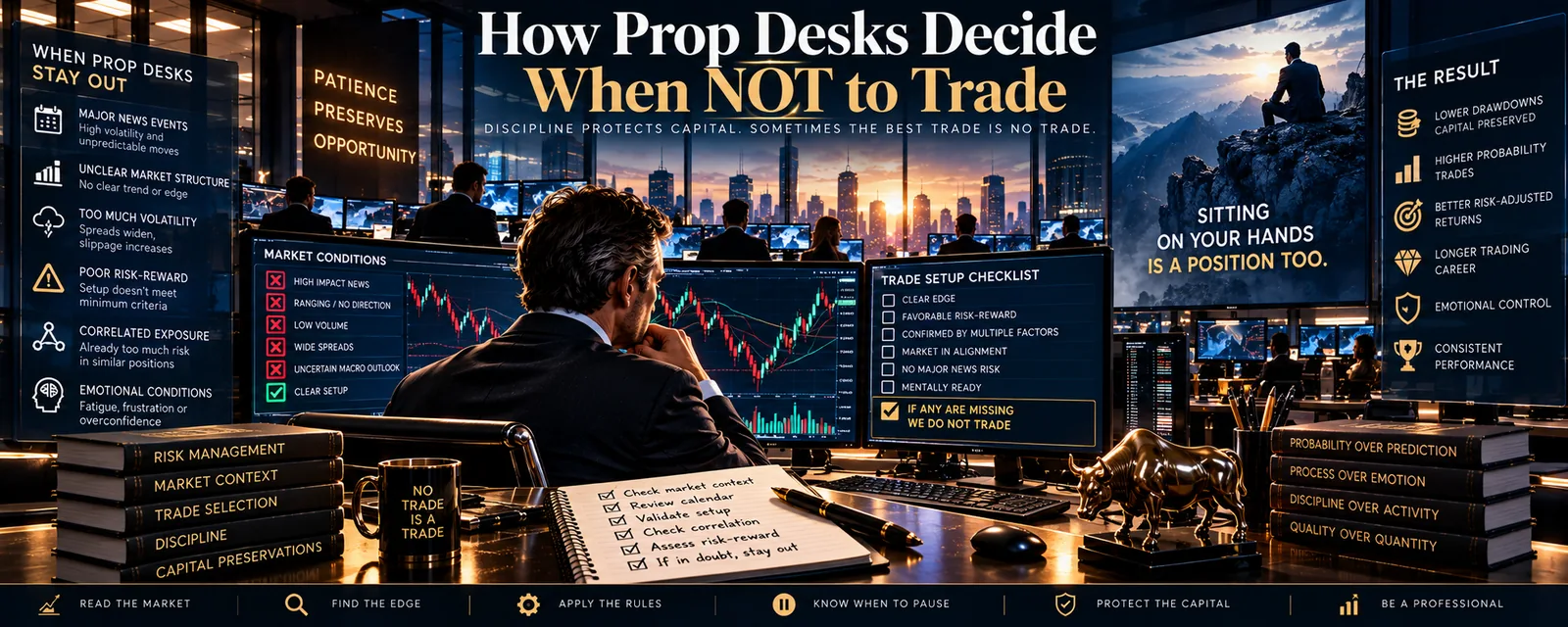
Before each session, and again before each order, a single yes below means stand aside or cut size.
Example no-trade checklist
| Check | Stand aside if |
|---|---|
| Daily loss limit | It has been reached |
| Consecutive losses | Three in a row today |
| Regime | Conditions do not suit the strategy |
| Calendar | High-impact event within the next few minutes |
| Spread and depth | Spread is well above normal |
| Open exposure | The new trade shares a driver with existing ones |
| Personal state | Tired, unwell, angry or euphoric |
| Setup grade | Below your minimum grade |
| Clarity | You cannot state the invalidation level |
On a desk, someone else enforces these rules. At home, the trader is both player and referee, and the referee is easy to bribe.
A few practical supports help. Many platforms and brokers allow a maximum daily loss setting. A trading partner can receive your daily result. A written rule taped beside the monitor is crude and surprisingly effective.
The key is to make the decision when calm. A limit chosen on Sunday evening is rational. A limit chosen after the third loss on Tuesday is negotiable.
Key takeaway. Prop desks earn their living from a small number of good conditions and protect themselves the rest of the time. Their edge is partly in what they refuse.
For a retail trader, the highest-value rule may be the least exciting one: a clear list of reasons not to trade, and the habit of obeying it.
Part 7 of 15 in the series Institutional Trading. Next: Why Big Money Can Afford to Be Patient.
Independent educational commentary, not investment advice. References to firms do not imply affiliation or endorsement. Figures in examples illustrate a method, not a recommended allocation or a promised outcome. Trading leveraged products carries a high risk of loss.
 AnalysisEducationTrade Like a Desk, Not Like a GamblerThe same entry can belong to a disciplined trading business or an impulsive bet. The difference sits around the order: a mandate, a repeatable setup, a risk budget and an honest review.@Abe5 min read
 AnalysisEducationThe Difference Between Finding a Trade and Manufacturing OneA valid setup starts with predefined conditions. A forced trade starts with the desire to be in the market, then searches for evidence to justify it. Both can look convincing on the same chart.@Abe5 min read
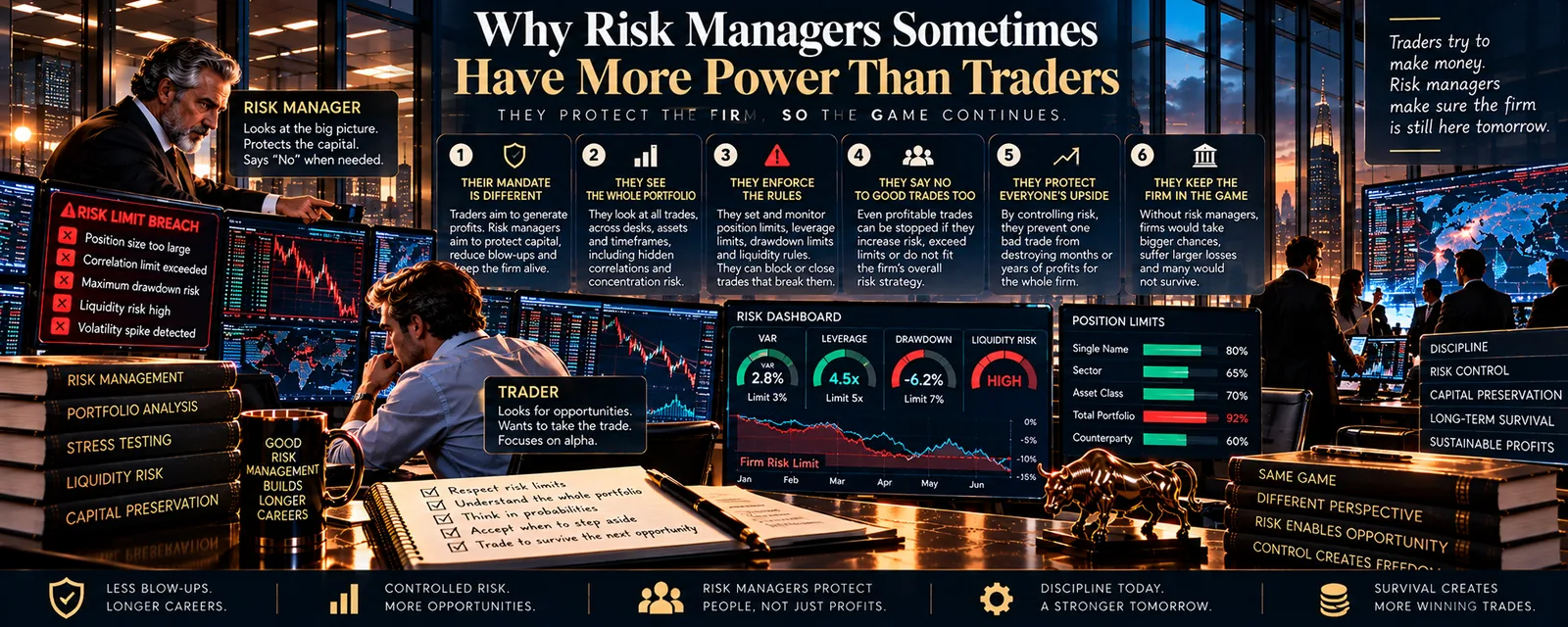 AnalysisEducationWhy Risk Managers Sometimes Have More Power Than TradersThe trader manages an opportunity; the risk function challenges whether the firm can afford it. When those judgments collide, effective governance gives risk officers the authority to reduce exposure and escalate the decision.@Abe6 min read
A short note from a GIO4X desk, filed under Education. It explains; it does not forecast and it does not tell you to trade. GIO4X is a broker and earns money when clients trade.
Editorial standardshttps://www.gio4x.com/intelligence/blog/how-prop-desks-decide-when-not-to-trade
Printed from gio4x.com.