Part 8 of 15The History of Trading
@AbePublished 3 min read

Fetching the page
Education · Explainer
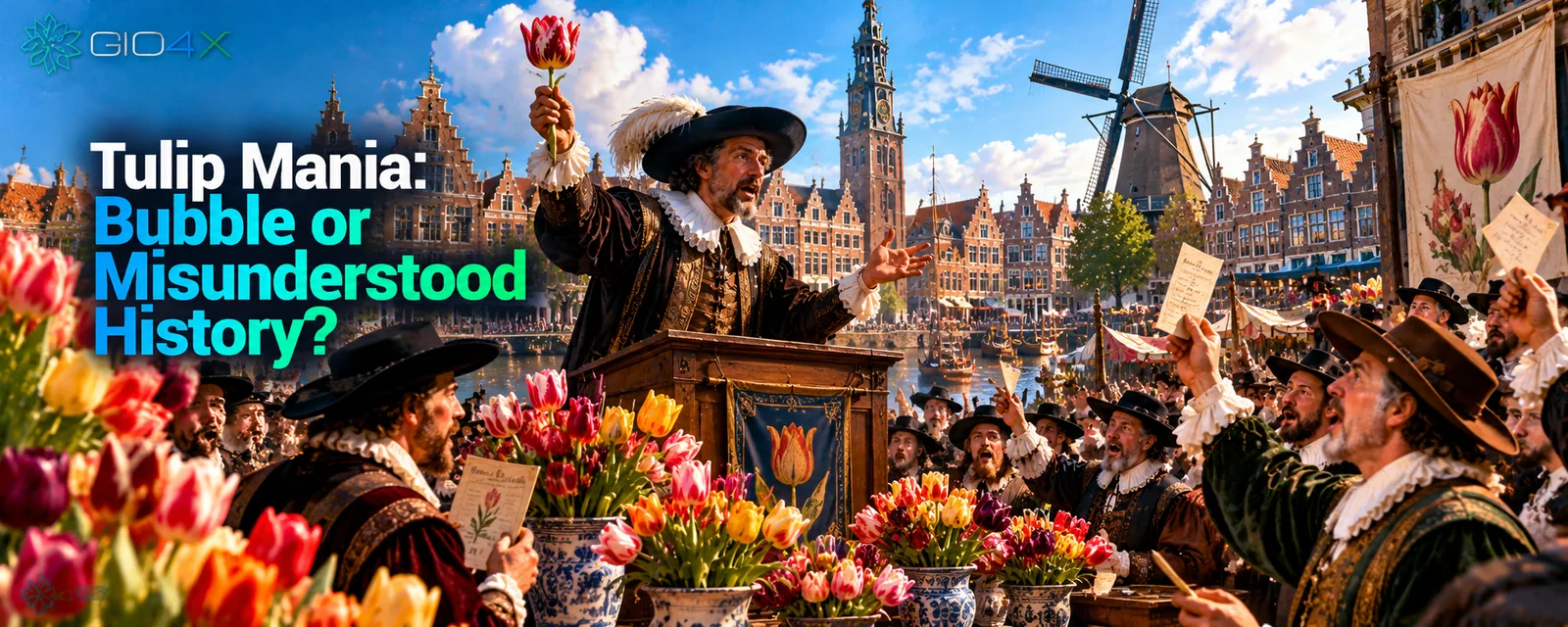
Rare flowers, rapidly rising contracts and a sudden loss of confidence made tulip mania real. The tale of an entire nation destroyed by bulbs is another matter. This is a story about speculation and the stories told about it.
Part 8 of 15The History of Trading
@AbePublished 3 min read
A flower costs a fortune. Ordinary people gamble away their homes. The market collapses, and a whole country learns a terrible lesson.
It is one of finance's most durable stories. It is also a story that becomes less tidy when historians inspect the evidence.
Tulip mania involved real speculation and a sharp collapse in early 1637. What deserves scrutiny is the larger claim attached to it: that the Dutch population collectively lost its senses and wrecked the economy through flower trading.
The difference is the point of this chapter. A memorable market story can survive long after its details have escaped verification.
Tulips had become desirable in Europe, and some were much rarer than others. Particularly prized were broken varieties with dramatic flames or feathering across their petals.
Those patterns were associated with a virus that also weakened the plants. Beauty and scarcity were therefore linked in a way growers could not simply solve by producing unlimited identical bulbs.
Semper Augustus became a legendary example of rarity. It is often used as shorthand for the most extravagant prices associated with the episode.
A high price for a rare collector's object does not automatically establish irrationality. People value beauty, distinction and scarcity. To understand a bubble, we need to examine how prices and expectations developed, not merely point at an expensive flower.
During the winter of 1636 to 1637, speculative interest extended to more ordinary bulbs. Contracts for later delivery changed hands, including in tavern gatherings, while the bulbs themselves remained in the ground.
That separation mattered. Participants could deal in an expected future delivery rather than physically exchange a blooming plant. A rising contract price could draw attention without new information about the underlying flower.
The more convincing the prospect of resale became, the easier it was to focus on the next buyer. This is an interpretation of the speculative mechanism, not proof that every participant had the same motive.
In early February 1637, buying failed at a Haarlem auction, and confidence rapidly broke. A market that had seemed crowded with willing buyers became a market in which completing the next transaction was the problem.
🧭 Why This Matters to Traders: An impressive quoted value depends on somebody accepting it. The disappearance of buyers can matter more quickly than any change in the physical asset.
Many dramatic retellings owe a debt to Charles Mackay's 1841 book about popular delusions. Mackay drew on earlier accounts, including moralising material written after the episode.
Those texts tell us something about how people judged speculation. They are not automatically reliable measurements of how many people traded, who lost money or what happened to the wider economy.
Historian Anne Goldgar examined Dutch archival evidence and challenged the familiar social portrait. Her research found a network concentrated among merchants and skilled artisans rather than the entire population recklessly participating. [1]
She also questioned the sweeping claims of mass bankruptcy. Contract enforcement and settlement were complicated; paper prices were not necessarily sums fully paid. The Dutch economy did not collapse in the way the popular legend suggests.
🔎 Did You Know? A contract's headline price, the amount ultimately settled and a participant's realised loss can be three different numbers. Treating them as interchangeable can make a financial episode look very different.
Correcting the legend does not mean declaring that nothing happened. There was a speculative surge. There was a reversal. Relationships and obligations were disrupted.
The correction concerns scale, participants and consequences. A real event in a limited market became a universal morality play about human foolishness.
That transformation should make traders curious about the stories they encounter today. Does a vivid anecdote represent the whole market? Is a dramatic number a completed transaction, an offer or a disputed promise?
🎯 Trader Takeaway: When somebody calls an asset the next tulip mania, ask which feature they mean: scarcity, rapid price appreciation, resale expectations, leverage or a vanishing market. An analogy becomes useful only when it becomes specific.
The lasting lesson is not that people sometimes get carried away. We already know that.
It is that even a warning against believing seductive stories can become a seductive story itself.
Part 8 of 15 in the series The History of Trading. Next: The South Sea Bubble.
 ExplainerEducationThe First Trade in Human HistoryLong before coins, contracts or candlestick charts, volcanic glass was travelling across ancient landscapes. The first chapter in our trading story begins with a sharp edge and a question of trust.@Abe4 min read
 AnalysisEducationHow Goldman Sachs Thinks About RiskThe first question in institutional trading is how much can be lost, how quickly, and who will act. Goldman Sachs offers a useful lens on that discipline: risk is measured, challenged and escalated throughout the life of a position.@Abe5 min read
 AnalysisEducationWhat Hedge Funds See That Retail Traders Usually MissThe chart shows price. A hedge fund also asks who holds the trade, what it costs to carry, and which other positions would lose alongside it. That wider view can change a decision before the first order is sent.@Abe5 min read
https://www.gio4x.com/intelligence/blog/tulip-mania-bubble-or-myth
Printed from gio4x.com.