Part 7 of 15The History of Trading
@AbePublished 3 min read

Fetching the page
Education · Explainer
Amsterdam did more than provide a place to trade shares. It brought buyers, sellers, contracts and rumours into a concentrated market whose behaviour still feels remarkably familiar.
Part 7 of 15The History of Trading
@AbePublished 3 min read
Before a stock exchange became an address, it was a meeting.
People needed somewhere to find counterparties, compare terms and hear what others believed. A market could begin wherever enough of them expected the others to arrive.
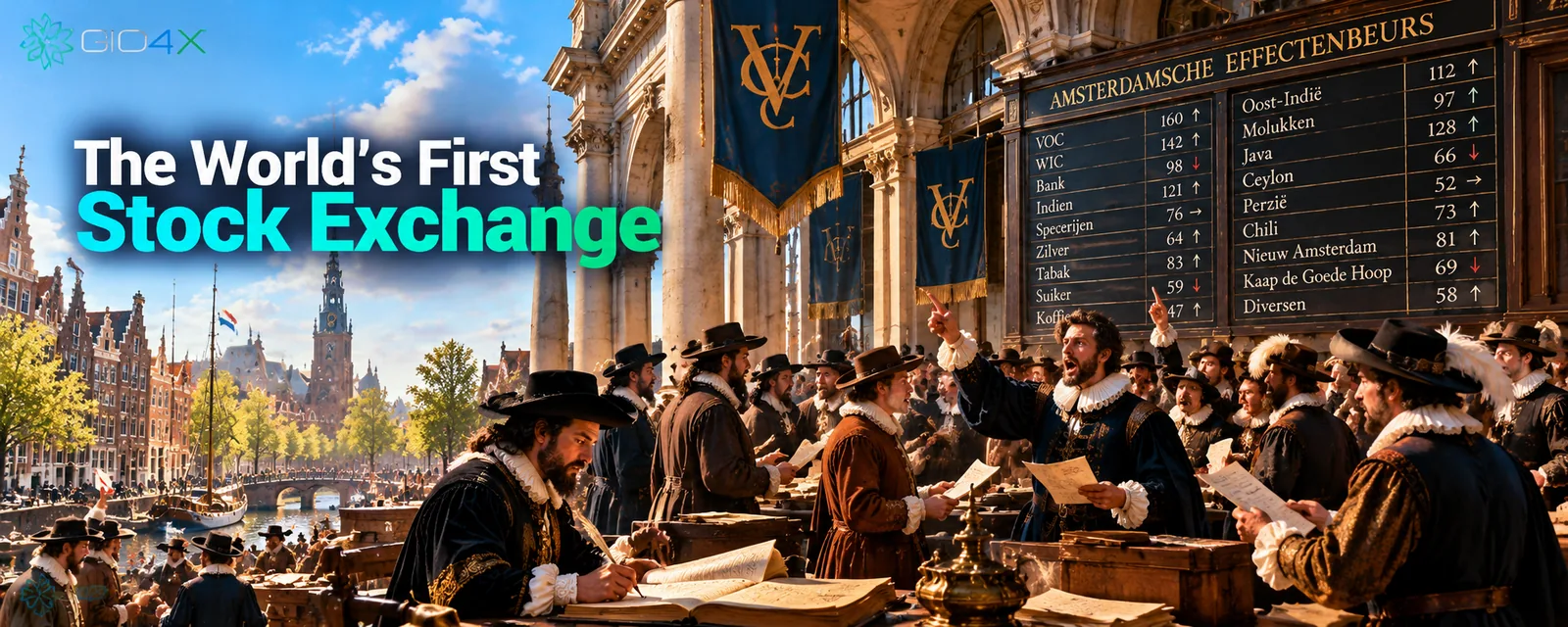
Amsterdam's early share trading took place on a bridge and in surrounding streets. That makes an appealing contrast with today's vast financial infrastructure. But the deeper connection is the same: participants needed a reliable place to find a price.
Merchants had gathered to trade long before VOC shares appeared. In Bruges, meetings associated with the Van der Beurze family helped give Europe the word bourse. Antwerp opened a purpose-built exchange in 1531.
Those earlier institutions are important. Calling Amsterdam the first stock exchange should not erase markets in commodities, commercial paper or other financial claims that preceded it.
Amsterdam's distinctive place in this story comes from the continuing trade in VOC shares after the company's establishment in 1602. An ongoing enterprise had transferable ownership, and those ownership claims acquired an active market.
The title depends on what we mean by stock exchange. Amsterdam is the conventional starting point for the modern share market described here, not the beginning of every form of organised finance.
In 1611, trading moved into a new exchange building with a courtyard and colonnades. Dealing hours were restricted, bringing buyers and sellers together within a concentrated period.
At first, a short session might seem less convenient than continuous access. But a market needs other people to be present when someone wants to trade. Gathering participants at the same time could make finding a counterparty easier.
The distinction remains useful: availability and liquidity are not identical. A venue may be technically open while offering little depth at the price a trader wants.
🧭 Why This Matters to Traders: The ability to place an order is different from the ability to complete it on reasonable terms. Who else is present matters as much as whether the door is open.
Over the following decades, Amsterdam developed sophisticated practices including forward contracts, options, margin arrangements and short selling. Brokers specialised, and intermediaries helped connect buyers and sellers.
A forward sets terms today for a later transaction. An option gives a contractual choice under specified conditions. Margin involves financing or collateral arrangements that let a position exceed the trader's initial cash commitment.
The historical contracts were not identical to every standardised instrument available today. Yet the economic problems are recognisable: delay payment, transfer risk, secure a price or express a view without immediately paying for a full purchase.
Small investors could also obtain fractional interests. Participation did not mean every person traded in the same size or on equal terms.
In 1688, Joseph de la Vega, a Sephardic Jewish merchant, published Confusion de Confusiones. Often described as the earliest book devoted to a stock market, it offers a vivid account of speculation and its participants.
His world contains optimism, pessimism, rumour, anxiety and the tendency to follow a crowd. The setting is historical. The emotional rhythm is easy to recognise.
His observations are valuable partly because they prevent a comforting mistake: blaming market psychology entirely on modern screens and social media. The channels have changed. The temptation to confuse popular conviction with reliable knowledge is much older.
🔎 Did You Know? De la Vega's stock-market writing appeared in 1688. The anxiety of watching a position and wondering whether to sell was already material for a book centuries before online brokerage.
Advice associated with de la Vega includes caution about giving share tips, accepting profits without endless regret and recognising that patience requires financial resources. These are paraphrased ideas, not a modernised quotation.
They belong together. Patience is easier to praise than to finance. A trader who needs immediate cash may not be free to wait for an opinion to prove correct.
🎯 Trader Takeaway: Study the market's rules and your own constraints together. A sound view can still become an unmanageable position if the timing, financing or exit conditions work against you.
The courtyard is gone from the modern trading screen. The need for another willing participant, and the emotions that gather around that need, are still there.
Part 7 of 15 in the series The History of Trading. Next: Tulip Mania: Bubble or Misunderstood History?.
 ExplainerEducationThe First Trade in Human HistoryLong before coins, contracts or candlestick charts, volcanic glass was travelling across ancient landscapes. The first chapter in our trading story begins with a sharp edge and a question of trust.@Abe4 min read
 AnalysisEducationHow Goldman Sachs Thinks About RiskThe first question in institutional trading is how much can be lost, how quickly, and who will act. Goldman Sachs offers a useful lens on that discipline: risk is measured, challenged and escalated throughout the life of a position.@Abe5 min read
 AnalysisEducationWhat Hedge Funds See That Retail Traders Usually MissThe chart shows price. A hedge fund also asks who holds the trade, what it costs to carry, and which other positions would lose alongside it. That wider view can change a decision before the first order is sent.@Abe5 min read
https://www.gio4x.com/intelligence/blog/worlds-first-stock-exchange-amsterdam
Printed from gio4x.com.