Part 6 of 15The History of Trading
@AbePublished 3 min read

Fetching the page
Education · Explainer
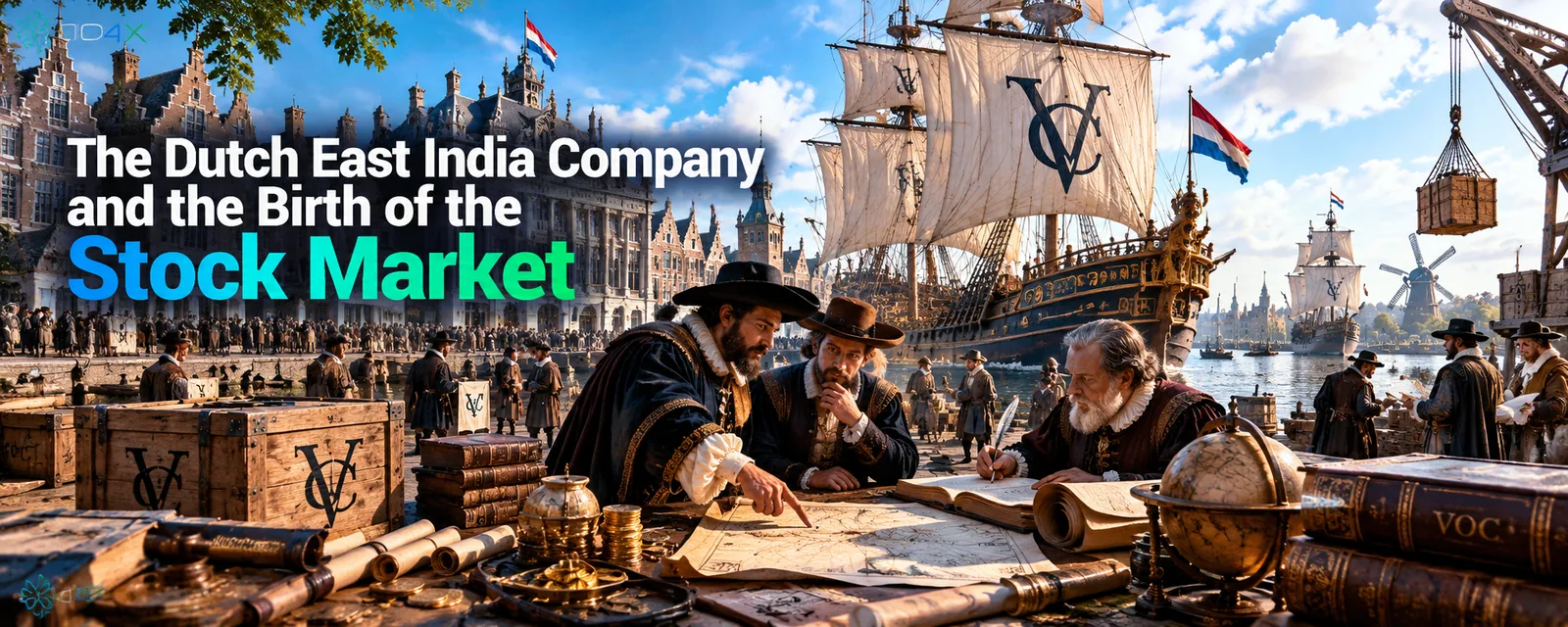
A voyage to Asia could tie up an investor's money for years. The VOC helped transform that problem by separating a company's need for lasting capital from an investor's desire to sell.
Part 6 of 15The History of Trading
@AbePublished 3 min read
The ship might come home rich. It might not come home at all.
For investors financing a spice voyage from Amsterdam to Asia around 1600, that uncertainty was difficult enough. The waiting made it worse. Money could be committed for years while ships, cargo and news travelled across immense distances.
A commercial venture needed patient capital. An individual investor might need cash before the venture was finished.
The Dutch East India Company's importance lies partly in the way it brought those competing needs together. The investor could leave without forcing the enterprise to stop.
In 1602, the Dutch Republic brought rival trading enterprises together in the Vereenigde Oostindische Compagnie, better known as the VOC. Its charter granted a 21-year monopoly over Dutch trade with Asia.
The company raised about 6.4 million guilders through subscriptions. Participants came from a wider social range than the wealthiest merchants alone, including people working in domestic service.
It was not the first moment in history when people pooled funds or shared an enterprise. Its significance was the scale and organisation of the arrangement, together with the development of an active market in transferable interests.
Investors were buying exposure to an ongoing business, rather than simply waiting for one voyage to finish and its proceeds to be divided.
Capital was committed for an extended period. An investor who wanted out could sell a share to another person rather than demand immediate repayment from the company.
This was the central change. The company could retain funding while ownership changed hands.
The secondary market gave investors a possible exit. It did not guarantee that the exit would be available at a good price. If potential buyers became pessimistic, a seller might have to accept less than expected.
That distinction remains essential. Transferability makes an asset tradable. It does not make its price stable or eliminate the possibility of loss.
🔎 Did You Know? A share sale between two investors generally transfers ownership rather than placing fresh money into the company's treasury. That is the difference between raising capital and trading an existing claim.
Rumours about cargoes, conflict and shipwrecks now had a place to register before an enterprise completed its work: the share price.
The business operated on the slow timetable of voyages. The market could react on the faster timetable of news, expectations and fear.
By 1609, former director Isaac Le Maire was organising a group to sell VOC shares short. The company sought restrictions. The conflict is strikingly familiar: pessimistic traders saw a reason to sell, while the company objected to trading it considered harmful.
Short selling did not arrive with a computer terminal. Neither did the suspicion directed at it.
🧭 Why This Matters to Traders: A security's price reflects what participants are willing to pay now for uncertain future outcomes. It is not a live inventory of the company's physical assets.
The VOC also possessed military and political powers, including the capacity to wage war. Its commercial history cannot be separated from coercion and colonial violence.
In 1621, the company's campaign on the Banda Islands devastated the local population as it pursued control of the nutmeg trade. That belongs at the centre of any honest account of how its commercial position was built.
Popular claims that it was the most valuable company ever depend on highly uncertain comparisons across centuries. Its scale and influence were extraordinary without requiring a modern-dollar superlative.
The company was dissolved in 1799 after deep financial and administrative decline. Its longevity did not make it immune to debt, corruption or failure.
The important distinction is between a corporate outcome and a financial mechanism. The VOC failed. An active market in transferable ownership endured.
🎯 Trader Takeaway: An asset can have an important place in financial history and still be a poor investment at a particular price. Innovation does not cancel valuation, governance or ethical questions.
The company needed money to stay at sea. Investors needed a way to step ashore. Tradable shares helped make both possible, and markets have been negotiating that relationship ever since.
Part 6 of 15 in the series The History of Trading. Next: The World's First Stock Exchange.
 ExplainerEducationThe First Trade in Human HistoryLong before coins, contracts or candlestick charts, volcanic glass was travelling across ancient landscapes. The first chapter in our trading story begins with a sharp edge and a question of trust.@Abe4 min read
 AnalysisEducationHow Goldman Sachs Thinks About RiskThe first question in institutional trading is how much can be lost, how quickly, and who will act. Goldman Sachs offers a useful lens on that discipline: risk is measured, challenged and escalated throughout the life of a position.@Abe5 min read
 AnalysisEducationWhat Hedge Funds See That Retail Traders Usually MissThe chart shows price. A hedge fund also asks who holds the trade, what it costs to carry, and which other positions would lose alongside it. That wider view can change a decision before the first order is sent.@Abe5 min read
https://www.gio4x.com/intelligence/blog/voc-birth-of-stock-market
Printed from gio4x.com.