Part 11 of 15The History of Trading
@AbePublished 3 min read
On this page
The dollar's name began in a valley. Its early model crossed oceans under a different empire. Its later authority came from institutions that did not yet exist when the word first circulated.
That is a more interesting origin than a currency simply being invented by the country whose name it now carries.
Money can acquire recognition before it acquires a new national identity. When the United States built its monetary system, it drew on something people already knew how to use.
⛏️ A valley became a word
In the early sixteenth century, silver mined around Joachimsthal in Bohemia, in today's Czech Republic, was made into large coins known as Joachimsthalers.
The name shortened to thaler. Related forms, including the Dutch daalder, belonged to the word's movement across languages. Dollar became an English term associated with large silver coins.
This is the linguistic beginning, not yet the creation of the U.S. currency. The word had a life before the nation adopted it.
The distinction is worth keeping. A monetary name can travel, change spelling and attach itself to new issuing authorities while retaining a familiar sound.
🌊 The coin that crossed the oceans
The Spanish peso of eight reales, widely known as the piece of eight, became an especially successful large silver coin. Silver from Spanish America, including Mexico and Peru, supported its extensive circulation.
It travelled through commercial networks reaching from Manila to the Atlantic world. In Britain's North American colonies, Spanish dollars were familiar and useful, while British coin was often scarce.
Acceptance could reinforce itself. A person was more willing to receive a coin if other people were likely to accept it later. Familiarity and confidence in its metal content supported that process.
Calling it an early global currency is a useful description of its reach. It does not mean every transaction everywhere used it or that every region had one monetary system.
🔎 Did You Know? The U.S. dollar borrowed from an existing monetary habit. Spanish dollars were already well known in the colonies before the federal mint produced American dollar coins.
🪙 A new republic chose a familiar unit
The American Revolution had also left a difficult experience with paper money. Continental currency depreciated severely, giving lasting force to the expression not worth a Continental.
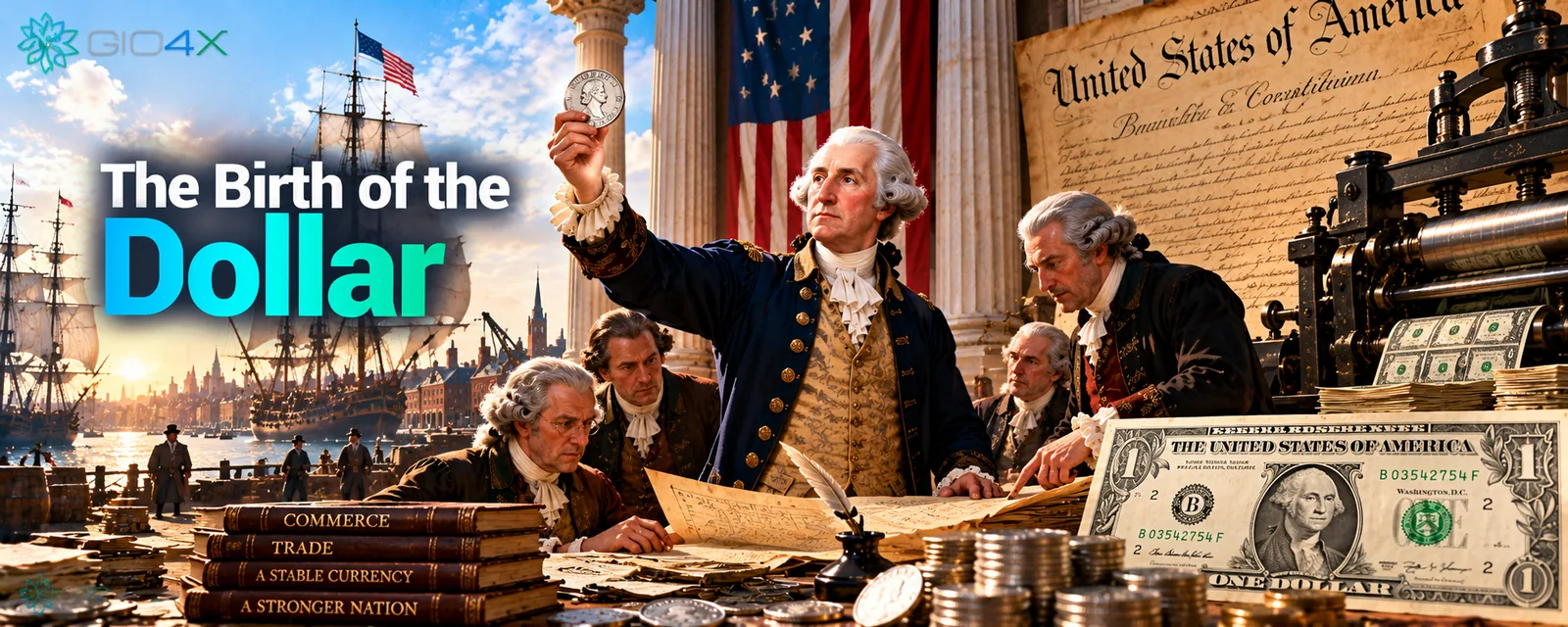
The Coinage Act of 1792 established the U.S. Mint and defined a coinage system that included a dollar modelled on the familiar Spanish monetary unit. The new system used decimal subdivisions, making one dollar equivalent to one hundred cents. [1]
The legislation covered gold and silver coins, so this should not be imagined as an exclusively silver monetary system. The silver dollar's specified weight nevertheless formed a central part of the definition.
Related posts
 ExplainerEducationThe First Trade in Human HistoryLong before coins, contracts or candlestick charts, volcanic glass was travelling across ancient landscapes. The first chapter in our trading story begins with a sharp edge and a question of trust.@Abe4 min read
 AnalysisEducation