Part 10 of 15The History of Trading
@AbePublished 3 min read

Fetching the page
Education · Explainer
Before Wall Street meant global finance, it described a lane beside a defensive wall. Its history runs through colonial conflict, slavery and a small agreement between brokers that helped shape a major exchange.
Part 10 of 15The History of Trading
@AbePublished 3 min read
There really was a wall.
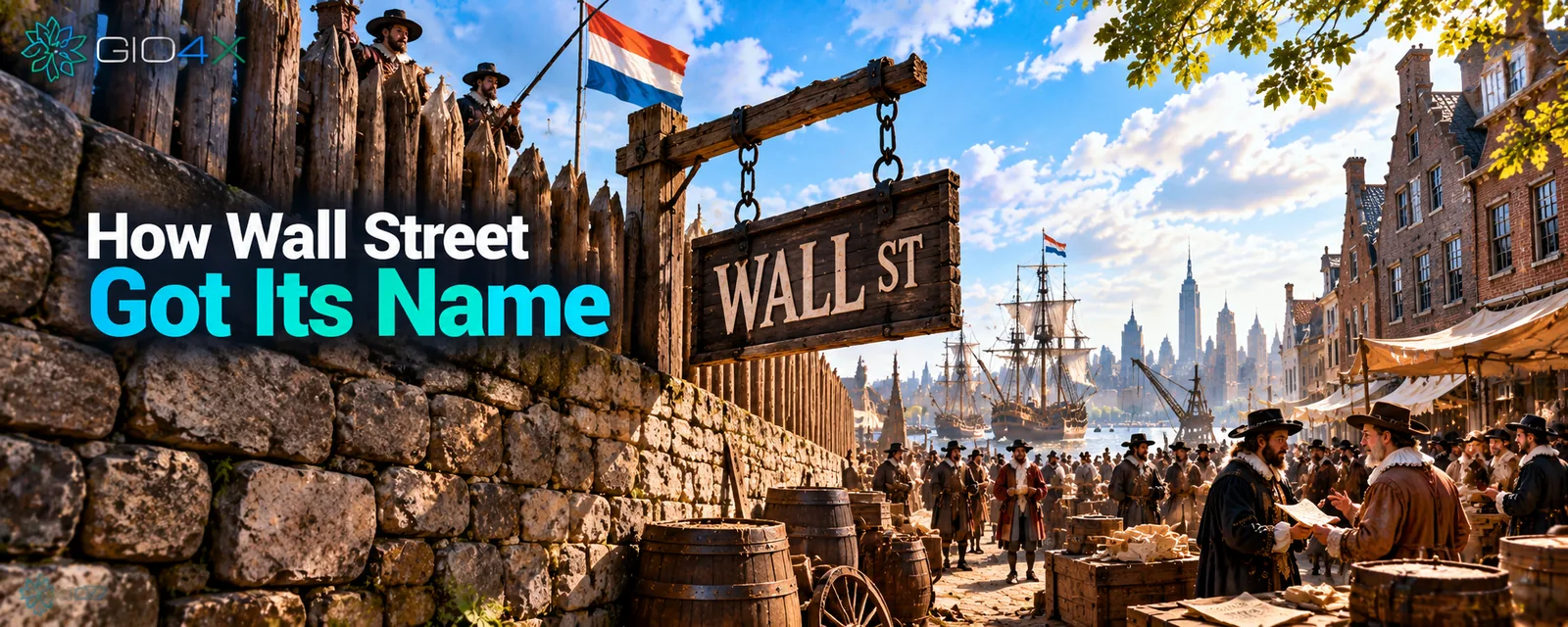
Before the name became shorthand for banks, brokers and the stock market, Wall Street was a lane beside a defensive barrier at the edge of a small colonial settlement.
That physical origin is easy to overlook. The modern name seems almost too large for a particular place. It represents an industry, a concentration of power and an argument about what finance does.
Its history starts with timber across Manhattan and continues through episodes that deserve to be remembered together, including the labour and lives of enslaved people.
In 1653, New Amsterdam occupied the southern end of Manhattan. With conflict between the Dutch and English creating anxiety, Governor Peter Stuyvesant ordered a wooden palisade across the settlement's northern boundary.
Enslaved Africans were among those who built it. The labour behind the structure is part of the street's origin, not a footnote to the later financial story. [1]
The lane running beside the wall acquired the name that endured. What began as a description of a local landmark eventually outlived the landmark itself.
The wall did not prevent the English takeover. In 1664, the English arrived by sea and the settlement surrendered. New Amsterdam became New York. The deteriorating palisade was removed in 1699, while the street retained its name.
In 1711, an official market for enslaved people was established at the foot of Wall Street. People were bought, sold and hired out there. Municipal records and historical sites preserve this part of the city's history. [1]
It changes how the familiar phrase commercial centre should be understood. Commerce in colonial New York included the treatment of human beings as property.
An account that moves directly from the wooden wall to successful brokers leaves out that reality. Telling the history fully does not weaken it. It makes the relationship between economic institutions and the society around them clearer.
There is no need to turn this suffering into a cheerful trading analogy. It belongs in the story because it happened and because the people involved deserve to be visible.
After independence, securities linked to the finances of the new United States helped draw brokers to Wall Street. Government debt needed a market, and buyers and sellers needed intermediaries.
Trading took place in a much less formal setting than the exchange associated with the street today. Brokers met and arranged transactions, sometimes outdoors.
On May 17, 1792, twenty-four brokers signed the Buttonwood Agreement. Tradition places the signing beneath a buttonwood tree outside 68 Wall Street. The surviving agreement is firmer evidence than every detail of the picturesque setting. [2]
The signatories committed to giving one another preference in dealings and to a minimum commission. It was an arrangement among participants with shared commercial interests.
🔎 Did You Know? The celebrated agreement included a minimum commission rule. The origins of an organised market can involve restrictions on competition as well as efforts to make dealing more dependable.
The agreement helped create the foundation for the organisation that became the New York Stock Exchange. A formal constitution followed in 1817. [2]
The sequence matters. An exchange is more than a place where prices are shouted. It is a set of arrangements defining participation, conduct and the terms on which people deal.
Such arrangements can make a market more workable for members while also excluding outsiders or protecting established interests. Efficiency and openness do not necessarily grow at the same pace.
🧭 Why This Matters to Traders: Market rules shape costs, access and competition. The price displayed on a screen sits inside an institutional structure that determines how you can interact with it.
🎯 Trader Takeaway: Learn the rules of the venue as carefully as the instrument traded there. Membership, commissions and dealing conventions can influence outcomes long before a view on price is tested.
Wall Street eventually became a name for far more than one road. Yet its earlier layers remain essential: a colonial defence, coerced labour, a slave market and an agreement among securities brokers.
The timber disappeared. The name carried everything that came after it.
Part 10 of 15 in the series The History of Trading. Next: The Birth of the Dollar.
 AnalysisEducationHow Warren Buffett Thinks About Price vs. ValueWarren Buffett's entire career rests on one distinction: price is what you pay, and value is what you get. The line comes from his teacher Benjamin Graham, and Buffett has repeated it for decades. Most investors nod at it and then spend their days watching prices.@Abe2 min read
 AnalysisEducationGeorge Soros and the Art of Being Wrong QuicklyGeorge Soros built one of the great trading records by assuming he was probably mistaken. Where most traders defend their views, Soros hunted for the flaw in his own. His edge was not prediction. It was the speed at which he abandoned a bad idea.@Abe2 min read
 AnalysisEducationStanley Druckenmiller: Bet Big Only When the Stars AlignStanley Druckenmiller ran Duquesne Capital for about three decades, averaged roughly 30% a year and never had a losing year. He did it by breaking a rule most investors treat as sacred. He did not diversify. He concentrated, but only on rare occasions.@Abe2 min read
https://www.gio4x.com/intelligence/blog/how-wall-street-got-its-name
Printed from gio4x.com.