Part 12 of 15The History of Trading
@AbePublished 3 min read
On this page
The war had not ended. The delegates were already planning what money would look like afterwards.
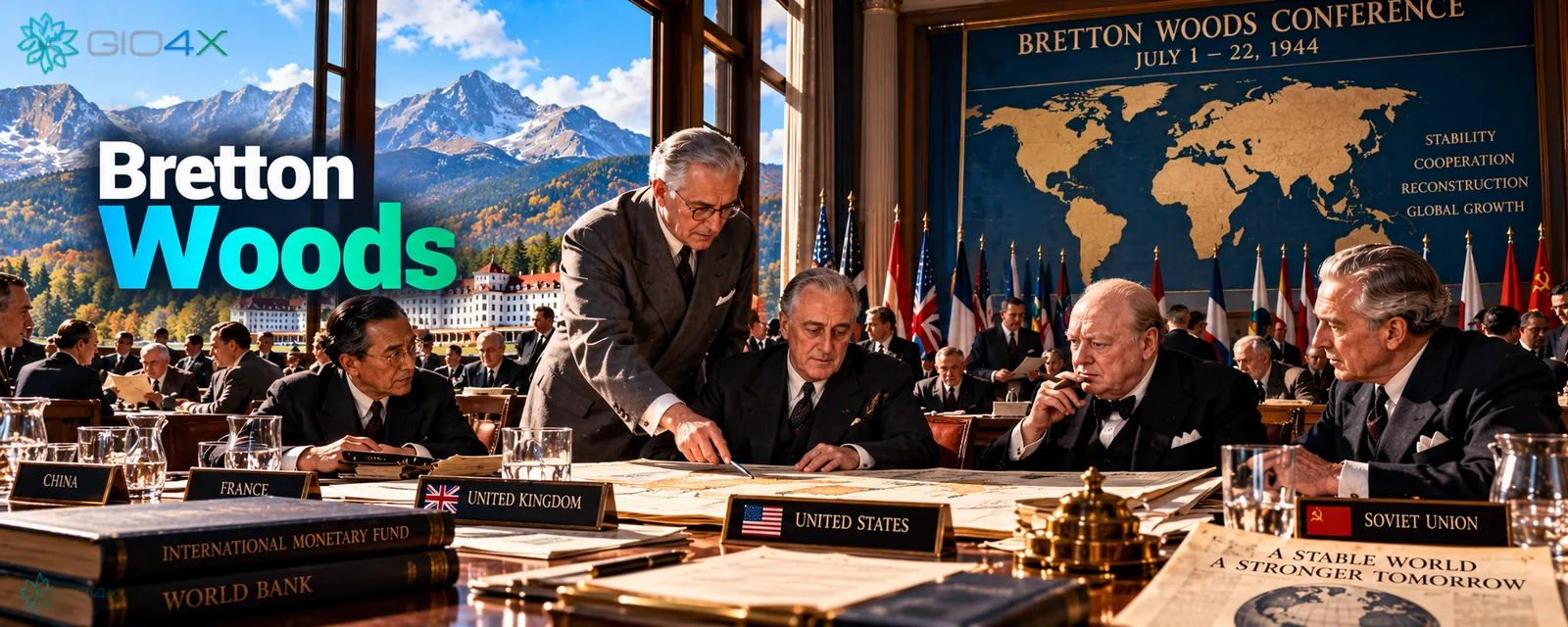
In July 1944, 730 delegates from 44 Allied nations gathered at the Mount Washington Hotel in Bretton Woods, New Hampshire. Their task was to build a monetary order that might avoid a repetition of the failures associated with the interwar years. [1]
Exchange rates were not an abstract technical concern. Currency instability, trade barriers and economic conflict had become part of the experience of the 1930s.
The people in the room wanted a framework in which reconstruction and trade would be easier to sustain. Agreeing that stability mattered did not mean agreeing on who should supply it.
🌍 Two designs and unequal power
John Maynard Keynes, representing Britain, proposed an international clearing arrangement centred on a new unit called bancor. His approach aimed to place pressure on persistent creditor countries as well as debtors to adjust imbalances.
Harry Dexter White, representing the United States, supported a system with the dollar at its centre. America's financial position and gold holdings gave that proposal considerable weight.
The resulting arrangement reflected the dollar-centred approach. This was economic design shaped by bargaining power, not simply a contest between ideas considered in isolation.
Britain and the United States entered the negotiations with different resources and constraints. Their preferences followed partly from those positions.
🪙 A chain of monetary promises
In outline, the system connected participating currencies to the dollar, while the dollar was linked to gold at $35 per ounce. Eligible foreign official holders could obtain gold for dollars at the official price.
That last qualification matters. Bretton Woods did not give every person holding a banknote a universal right to walk into a bank and demand gold.
Currency parities were intended to be stable but adjustable under specified circumstances. Maintaining them required policies and intervention, not merely an announcement of the desired number.
The conference also produced the framework for the International Monetary Fund and the International Bank for Reconstruction and Development, the original institution at the centre of the World Bank. [1]
🔎 Fact Box: July 1944, conference. Forty-four Allied nations represented. Dollar-gold anchor, $35 per ounce. Currency relationships, fixed but adjustable rather than permanently immutable.
🏗️ Stability helped planning
For a business making cross-border commitments, a relatively predictable exchange relationship could reduce one source of uncertainty. The exchange-rate framework became part of the environment in which postwar trade and reconstruction expanded.
Related posts
 ExplainerEducationThe First Trade in Human HistoryLong before coins, contracts or candlestick charts, volcanic glass was travelling across ancient landscapes. The first chapter in our trading story begins with a sharp edge and a question of trust.@Abe4 min read
 AnalysisEducation