Part 13 of 15The History of Trading
@AbePublished 4 min read

Fetching the page
Education · Explainer
On August 15, 1971, a presidential broadcast changed the dollar's international promise. The gold window closed, a repair attempt failed, and major currencies moved towards the floating-rate world traders know today.
Part 13 of 15The History of Trading
@AbePublished 4 min read
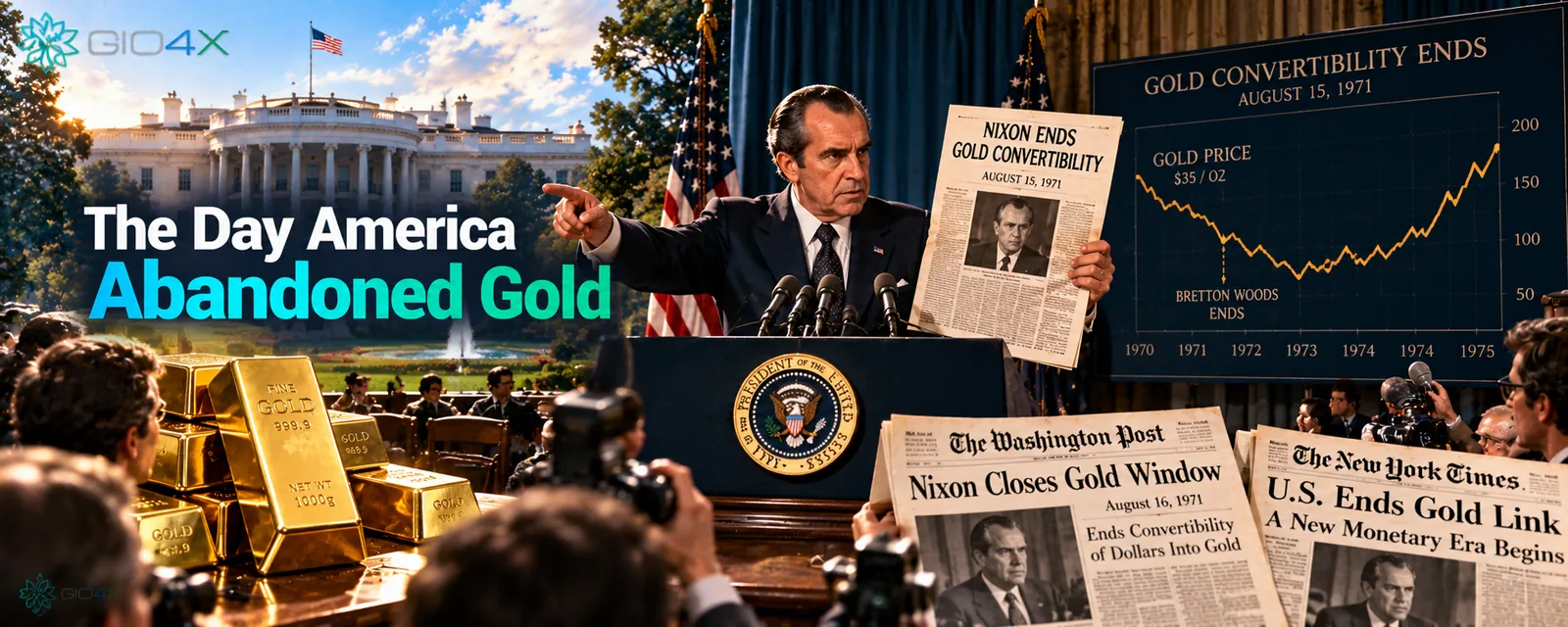
It was Sunday evening, August 15, 1971. President Richard Nixon appeared on television and announced a change that reached far beyond the living rooms watching him.
The United States would suspend the dollar's conversion into gold for foreign official holders. The gold window was closing.
Nixon presented the measure as temporary. Its consequences became permanent features of the international monetary system.
This was not the first time in history that money had existed without precious-metal backing. Nor did every currency immediately begin to float that evening. What ended was a crucial U.S. commitment underpinning Bretton Woods. [1]
The problem had been developing for years. Dollars accumulated outside the United States while confidence in the promise to exchange them for gold at $35 an ounce weakened.
American spending, inflation and balance-of-payments pressures formed part of the background. The Vietnam War and domestic programmes contributed to the wider fiscal setting, but the international problem cannot be reduced to one spending category.
Foreign official holders had reason to wonder whether the arrangement would last. Converting sooner could appear safer than waiting for a possible change in terms.
France was prominent among the countries challenging the dollar-centred system and seeking gold. The underlying issue was broader than any one country's actions: claims had grown relative to confidence in the conversion commitment.
🧭 Why This Matters to Traders: A promise can become vulnerable before it is formally withdrawn. Participants may act on the expected difficulty of honouring it, accelerating the pressure on the institution making it.
Nixon and his advisers settled the package during a private weekend at Camp David. Closing the gold window was accompanied by a 10 percent import surcharge and a 90-day freeze on wages and prices. [1]
These measures addressed different parts of the administration's economic problem. The international monetary action, trade measure and domestic controls should not be collapsed into one policy.
The announcement also mattered as a communication event. Other governments had built decisions around the existing rules. A sudden change in those rules required them to reassess their own positions.
The phrase Nixon Shock captures that abruptness. The official statement changed what counterparties could demand, not merely what commentators expected.
The Smithsonian Agreement in December 1971 attempted to rebuild a system of fixed exchange relationships with revised rates. It did not restore the old gold-conversion arrangement.
For a time, officials tried to preserve an adjusted version of stability. Market pressures continued. By March 1973, major currencies were moving to floating rates. [2]
The chronology is important. The transition was a sequence: suspension, attempted repair and then the broader move towards floating. A single dramatic broadcast began a process rather than completing every institutional change at once.
🗓️ Timeline: August 15, 1971, gold conversion suspended. December 1971, Smithsonian Agreement. March 1973, major currencies move to floating exchange rates.
Under a floating arrangement, the exchange rate could adjust through market trading, although governments and central banks could still intervene. Floating did not mean public institutions became irrelevant.
For businesses with payments in different currencies, changing rates brought a more visible source of uncertainty. The value of a future receipt or payment could shift before it was settled.
The wider monetary environment was changing too. Fiat money relies on monetary institutions, law and public confidence rather than a promise of conversion into a fixed weight of gold.
The 1970s brought severe inflation, with several interacting causes, including policy choices and supply shocks. Gold's dollar price eventually rose above $800 in 1980. That path should not be presented as the mechanical result of one announcement or as an uninterrupted ascent.
The hardest market changes are sometimes changes in the framework itself. A strategy built around an official conversion rate is exposed to a different problem when conversion is withdrawn.
🎯 Trader Takeaway: Distinguish movement within a monetary regime from a change in the regime. Historical price stability is weak protection when the rule producing that stability can be altered.
In 1971, the dollar did not disappear. Its international promise changed. Within two years, major currency markets were doing more of the work that official parities had once performed.
The gold window closed. The exchange-rate screen became harder to ignore.
Part 13 of 15 in the series The History of Trading. Next: How Forex Became a Global Market.
 ExplainerEducationThe First Trade in Human HistoryLong before coins, contracts or candlestick charts, volcanic glass was travelling across ancient landscapes. The first chapter in our trading story begins with a sharp edge and a question of trust.@Abe4 min read
 AnalysisEducationHow Goldman Sachs Thinks About RiskThe first question in institutional trading is how much can be lost, how quickly, and who will act. Goldman Sachs offers a useful lens on that discipline: risk is measured, challenged and escalated throughout the life of a position.@Abe5 min read
 AnalysisEducationWhat Hedge Funds See That Retail Traders Usually MissThe chart shows price. A hedge fund also asks who holds the trade, what it costs to carry, and which other positions would lose alongside it. That wider view can change a decision before the first order is sent.@Abe5 min read
https://www.gio4x.com/intelligence/blog/day-america-abandoned-gold-1971
Printed from gio4x.com.