Part 14 of 15The History of Trading
@AbePublished 4 min read

Fetching the page
Education · Explainer
Floating rates, electronic dealing and cross-border business transformed foreign exchange. Follow the market from telephone quotes to global screens, policy confrontations and the arrival of retail access.
Part 14 of 15The History of Trading
@AbePublished 4 min read
A company can sell the right product at the right price and still find that a currency movement changes what it earns.
That practical problem sits beneath the enormous foreign-exchange market. Forex is not only a contest between people with opinions about charts. It is also part of how businesses pay, investors move capital and institutions manage obligations across currencies.
The move to floating major exchange rates in 1973 made those changing currency values more prominent. A number that policy had tried to keep stable now demanded continuous attention.
Foreign exchange existed long before Bretton Woods ended. Banks handled payments, forward transactions and currency pressures even under fixed rates. The earlier system was not a world without currency trading.
What changed was the scale and character of exchange-rate risk when major currencies floated. Businesses expecting foreign-currency receipts or payments had stronger reasons to consider hedging. Financial institutions needed prices for transactions and ways to manage the resulting positions.
A hedge does not make every business outcome certain. It can reduce a specified exposure, usually with costs or trade-offs. Its purpose differs from taking a position solely to profit from a forecast.
That diversity of motives helps explain the market. Two parties can willingly trade because they have different obligations, not simply because one must be ignorant of the other's information.
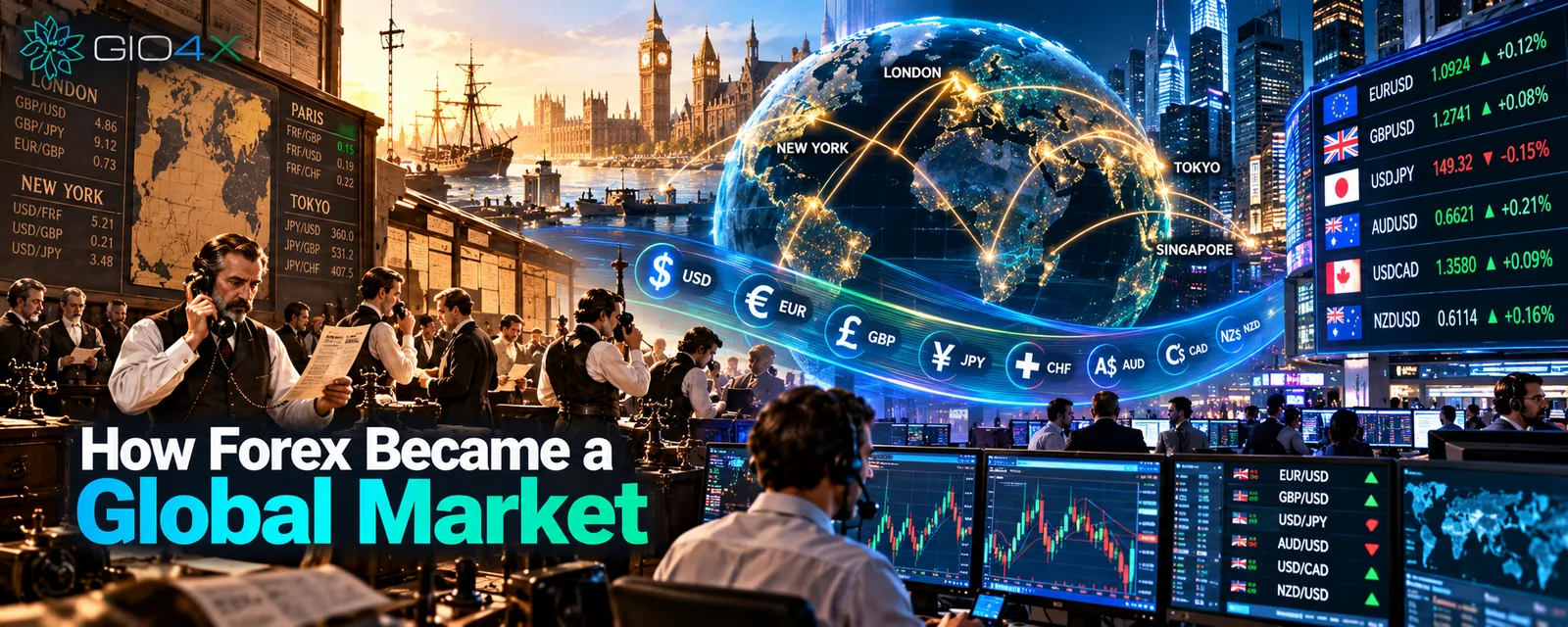
Dealers had relied on telephone and telex to seek quotes and arrange transactions. The process depended on communication with counterparties and knowledge of who might offer a competitive price.
Reuters introduced Monitor in 1973, bringing rates onto terminals. In 1981, its dealing service enabled electronic communication to agree transactions. The distinction matters: seeing information on a screen and completing a deal electronically were separate steps. [1]
The 1990s brought electronic matching platforms such as EBS. Bids and offers could meet through systems rather than every negotiation requiring a fresh telephone conversation.
Technology reduced some frictions and changed the pace of response. It did not remove credit relationships, settlement obligations or differences in access.
🔎 Did You Know? Foreign exchange has no single central exchange for the entire market. Different venues and bilateral relationships form a connected system rather than one universal order book.
In 1985, the Plaza Accord brought five major economies together in an effort to bring the dollar down. Policy cooperation could influence currency expectations as well as the actual flow of transactions.
In 1992, the confrontation around sterling showed another possibility. On September 16, Black Wednesday, the British authorities struggled to maintain the pound within Europe's exchange-rate mechanism.
The Bank of England intervened, and the government raised interest rates and announced a further increase before abandoning the defence. The announced further increase to 15 percent was never implemented, a distinction lost in some summaries. [3]
George Soros's fund was among the prominent speculators positioned against sterling and reportedly made around $1 billion. The episode should not be reduced to one trader overpowering a country single-handedly. The credibility and economic costs of the policy were central.
🧭 Why This Matters to Traders: A government's stated preference and its willingness to bear the cost of defending that preference are different questions. Policy credibility depends on constraints as well as words.
Internet brokers in the late 1990s and afterwards expanded retail access to live prices and leveraged currency products. Individuals had used currency services and other routes earlier; online brokerage widened access rather than inventing it from nothing.
A small account could now interact with prices from a vast market. That did not mean the retail account received every advantage available to a large institution.
Leverage increased the exposure obtainable from a given deposit. It also increased how quickly an adverse move could consume that deposit. Greater access and greater safety are not synonyms.
The Bank for International Settlements measured average daily OTC foreign-exchange turnover at $7.5 trillion in April 2022. Its April 2025 survey reported $9.6 trillion. These are dated survey measures across FX instruments, including derivatives, not the value of retail spot trading alone. [2]
The market follows the business day through centres including Sydney, Tokyo, London and New York. It is commonly described as a 24-hour market during the working week, with activity and liquidity varying by session and holiday.
🎯 Trader Takeaway: Identify the instrument, counterparty, trading session and settlement terms behind a forex quote. The size of the global market does not guarantee depth or favourable execution for every trade.
Forex became enormous because the world kept creating reasons to exchange currencies. The screen condensed those reasons into prices. Understanding the reasons remains the trader's work.
Part 14 of 15 in the series The History of Trading. Next: From Trading Floors to Algorithms.
 ExplainerEducationThe First Trade in Human HistoryLong before coins, contracts or candlestick charts, volcanic glass was travelling across ancient landscapes. The first chapter in our trading story begins with a sharp edge and a question of trust.@Abe4 min read
 AnalysisEducationHow Goldman Sachs Thinks About RiskThe first question in institutional trading is how much can be lost, how quickly, and who will act. Goldman Sachs offers a useful lens on that discipline: risk is measured, challenged and escalated throughout the life of a position.@Abe5 min read
 AnalysisEducationWhat Hedge Funds See That Retail Traders Usually MissThe chart shows price. A hedge fund also asks who holds the trade, what it costs to carry, and which other positions would lose alongside it. That wider view can change a decision before the first order is sent.@Abe5 min read
https://www.gio4x.com/intelligence/blog/how-forex-became-global-market
Printed from gio4x.com.