Part 14 of 15Lessons From the Masters
@AbePublished 3 min read

Fetching the page
Education · Analysis
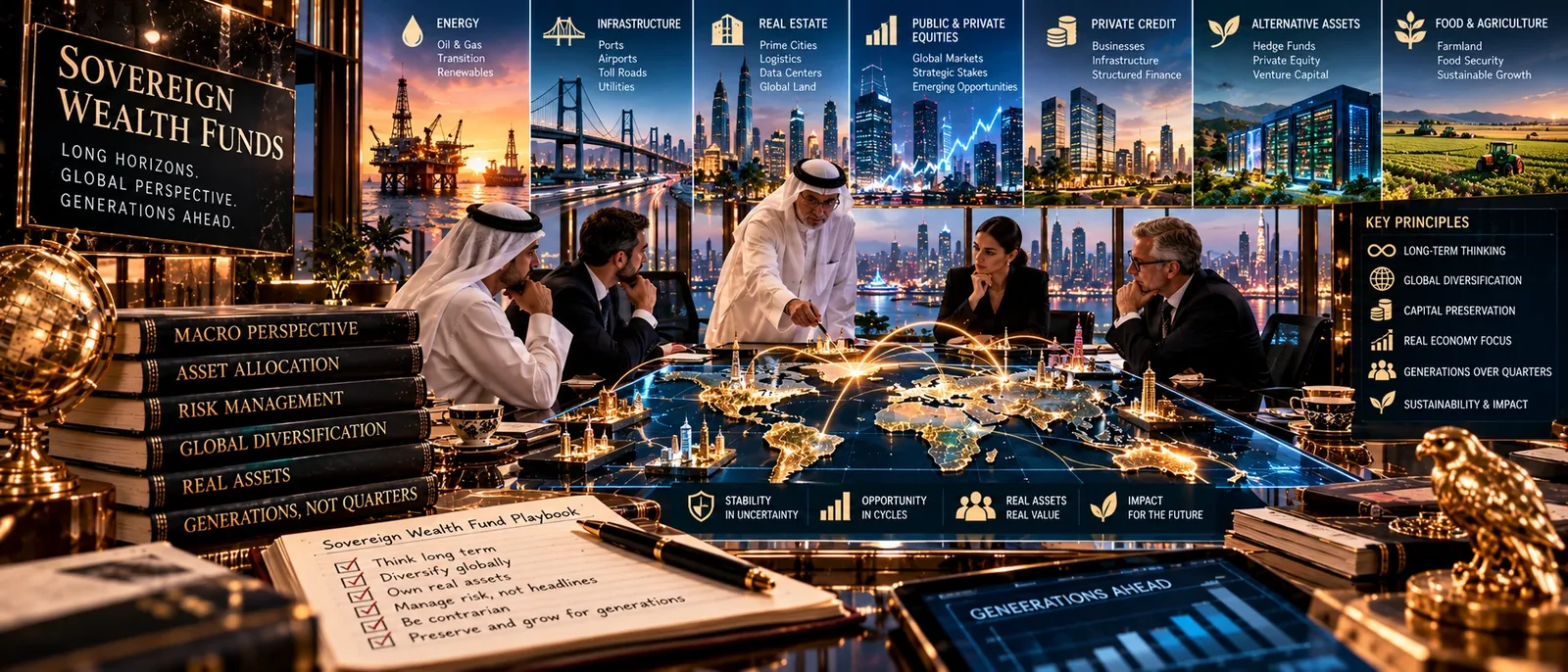
Sovereign wealth funds invest for citizens who are not yet born. They are state-owned pools of capital, usually built from oil revenue or trade surpluses, and together they manage trillions of dollars. Their time horizon is longer than that of almost any other investor.
Part 14 of 15Lessons From the Masters
@AbePublished 3 min read
Sovereign wealth funds invest for citizens who are not yet born. They are state-owned pools of capital, usually built from oil revenue or trade surpluses, and together they manage trillions of dollars. Their time horizon is longer than that of almost any other investor.
Kuwait set up the first such fund in 1953 to invest its oil income. The logic has not changed. Oil in the ground is a finite asset, and a fund converts it into financial assets that can last.
Norway's Government Pension Fund Global, the largest, follows this model. Abu Dhabi, Kuwait, Saudi Arabia and Qatar do too. Singapore's GIC and Temasek, and China's CIC, were built instead from trade surpluses and reserves.
| Type | Purpose | Typical behaviour |
|---|---|---|
| Stabilisation funds | Smooth the budget when commodity prices fall | Liquid, conservative holdings |
| Savings funds | Pass wealth to future generations | Equity-heavy, long-term |
| Development funds | Build domestic industries | Large strategic and direct stakes |
Much confusion about sovereign funds comes from treating these as one group. Norway's fund and Saudi Arabia's Public Investment Fund behave very differently because they were given different tasks.
A savings fund has no clients who can withdraw and few short-term liabilities. It can therefore hold volatile and illiquid assets through deep downturns.
Norway's fund kept buying shares through the 2008 crisis because its rules required rebalancing back to its equity target. That discipline, set in advance, did what human nerve might not have.
The largest funds are too big to pick their way to outperformance. Norway's fund owns well over 1% of all listed shares in the world, across thousands of companies. Its return is mostly the market's return.
Funds seek extra return in other ways:
The biggest threat to a sovereign fund is political. Governments are tempted to raid it in hard times or direct it towards favoured projects.
The best-run funds have fiscal rules. Norway limits annual government spending from the fund to its expected real return, about 3%. The capital itself is not meant to be touched.
With stakes in thousands of companies, large funds cannot simply sell what they dislike. They vote, engage with boards and publish their expectations on governance and climate risk. Some exclude companies on ethical grounds.
Part 14 of 15 in the series Lessons From the Masters. Next: How Billionaires Protect Money After They Make It.
Independent educational commentary, not investment advice. References to people and firms do not imply affiliation or endorsement. The picture is an illustration, not a photograph. Past results say nothing about future ones. Trading leveraged products carries a high risk of loss.
 AnalysisEducationThe Investment Habits of Family OfficesFamily offices invest to stay rich, not to get rich. A family office is a private firm that manages one wealthy family's money, and sometimes several families'. Its owners have already made their fortune, usually from a single business, and that shapes every habit below.@Abe3 min read
 AnalysisEducationHow Billionaires Protect Money After They Make ItMaking a fortune and keeping one require opposite behaviour. Wealth is usually made through concentration: one company, heavy risk, years of all-in commitment. It is kept through diversification, liquidity and caution.@Abe3 min read
 AnalysisEducationRay Dalio and the Machine Behind RiskRay Dalio treats the economy as a machine and investing as an engineering problem. He founded Bridgewater Associates in 1975 from his New York apartment and grew it into one of the world's largest hedge funds. His method came out of a failure that nearly ended the firm.@Abe2 min read