Part 5 of 15Lessons From the Masters
@AbePublished 2 min read

Fetching the page
Education · Analysis
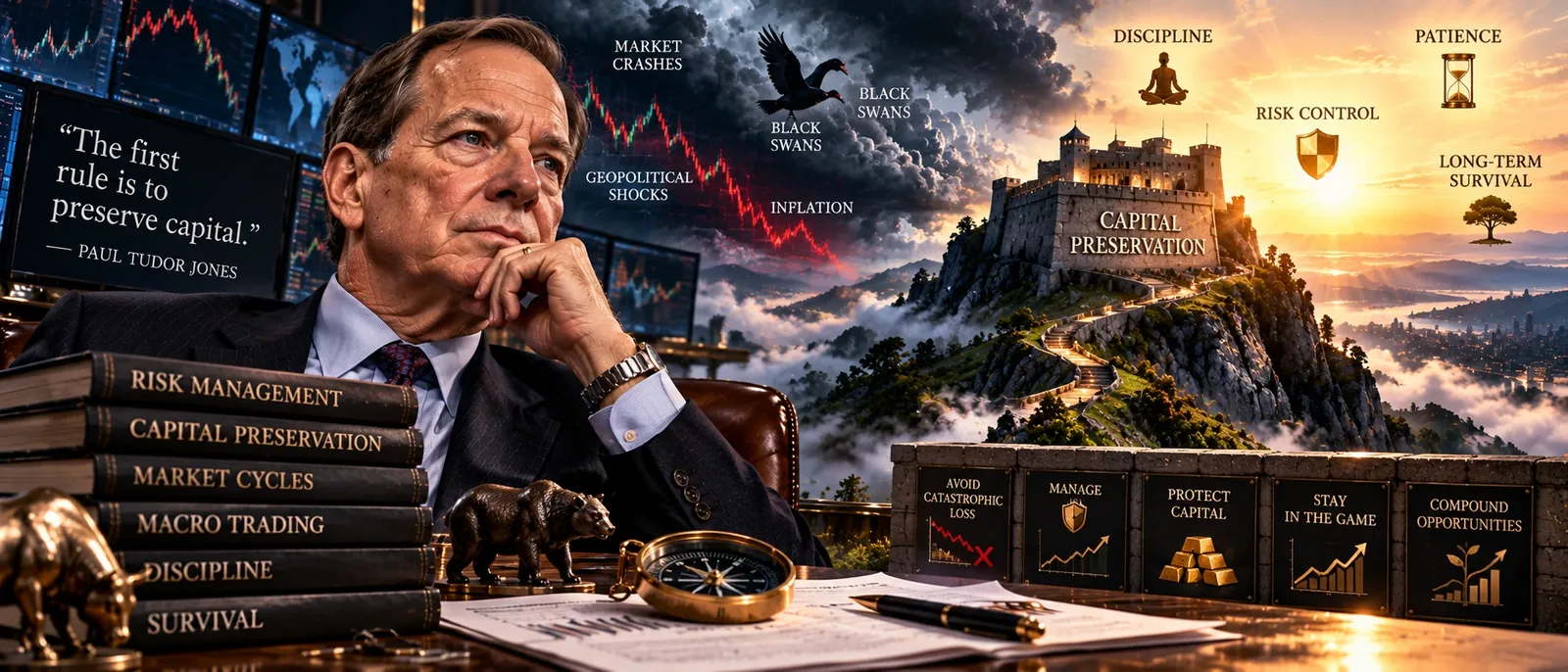
Paul Tudor Jones is famous for calling the 1987 crash, when his fund more than doubled while markets collapsed. He would say that is the wrong thing to remember him for. His real skill is defence. He spends his day thinking about how much he can lose, not how much he can make.
Part 5 of 15Lessons From the Masters
@AbePublished 2 min read
Paul Tudor Jones is famous for calling the 1987 crash, when his fund more than doubled while markets collapsed. He would say that is the wrong thing to remember him for. His real skill is defence. He spends his day thinking about how much he can lose, not how much he can make.
Jones started as a cotton trader and founded Tudor Investment Corporation in 1980. Early in his career he took an oversized cotton position, got caught, and lost a large share of his clients' money in one trade. He has said that day changed him.
Since then, his first question on any trade is where he gets out. He assumes each position is wrong until the market proves otherwise.
Jones uses the 200-day moving average as a simple filter across markets. When price is below it, he gets out or gets defensive. The rule is crude, and he knows it.
Its value is that it prevents catastrophe. No market falls 50% without first crossing its long-term average. A rule that removes the worst outcomes does not need to be clever.
Jones and his colleague Peter Borish compared the 1980s market with the 1920s and saw a close resemblance. They were positioned short ahead of October 1987. The preparation mattered, but so did the willingness to act on it when the break came.
Note what he did not do. He did not bet the firm on the forecast. He sized the position so that being wrong would have been survivable.
A 50% loss needs a 100% gain to recover. A 10% loss needs 11%. Avoiding deep drawdowns is not caution for its own sake. It is the arithmetic of compounding.
Jones also treats capital as mental capital. A trader in a deep drawdown thinks badly, and bad thinking produces the next loss.
Part 5 of 15 in the series Lessons From the Masters. Next: Jesse Livermore: Genius, Leverage and Ruin.
Independent educational commentary, not investment advice. References to people and firms do not imply affiliation or endorsement. The picture is an illustration, not a photograph. Past results say nothing about future ones. Trading leveraged products carries a high risk of loss.
 AnalysisEducationGeorge Soros and the Art of Being Wrong QuicklyGeorge Soros built one of the great trading records by assuming he was probably mistaken. Where most traders defend their views, Soros hunted for the flaw in his own. His edge was not prediction. It was the speed at which he abandoned a bad idea.@Abe2 min read
 AnalysisEducationStanley Druckenmiller: Bet Big Only When the Stars AlignStanley Druckenmiller ran Duquesne Capital for about three decades, averaged roughly 30% a year and never had a losing year. He did it by breaking a rule most investors treat as sacred. He did not diversify. He concentrated, but only on rare occasions.@Abe2 min read
 AnalysisEducationJim Simons: When Mathematics Went to Wall StreetJim Simons built the most profitable trading operation in history without hiring anyone from Wall Street. His Medallion Fund averaged about 66% a year before fees from 1988 to 2018, according to Gregory Zuckerman's account of the firm.@Abe2 min read